Every month, most people watch money flow in and out without really knowing where it goes. The payslip shows a gross figure, taxes come off the top, expenses pile up — and at month-end, what’s left rarely adds up to what was expected. Behind all of this is one discipline: finance.
\nAccording to Italy’s Edufin Index 2025, Italians score 56 out of 100 on financial literacy — below the sufficiency threshold. A striking number for something that affects every decision we make. This guide explains what finance really is, how each of its branches works, and what you can do with that knowledge.
\nFinance: a definition that goes beyond numbers
\nDictionaries define finance as the science that studies how money is allocated among different parties over time. Accurate, but not very useful in practice.
\nPut simply, finance is the art of managing money. It covers how you earn it, spend it, save it, and make it grow — whether you’re an individual, a business with thousands of employees, or a national government.
\nFinance breaks down into three main areas:
\n- \n
- Personal finance — how you manage your own money day to day \n
- Corporate finance — how businesses fund their operations \n
- Public finance — how governments collect and redistribute resources \n
There’s also a fourth pillar that often gets overlooked: financial markets — the largely digital arena where the supply and demand for money meet. Understanding the basics of each area gives you a meaningful edge in everyday life.
\nPersonal finance: managing money in daily life
\nThis is the branch of finance closest to you. Every time you decide whether to buy something on installments or pay upfront, whether to open a savings account or leave money in your checking account, you’re making personal finance decisions — whether you realize it or not.
\nPersonal finance rests on four pillars.
\nIncome and expenses. How much comes in and how much goes out each month. It sounds obvious, yet a 2025 YouGov survey found that nearly 45% of Italians can’t explain the difference between a stock and a bond. If you don’t know where your money goes, you can’t control it.
\nSaving. The golden rule is simple: pay yourself first. Set aside a fixed percentage of your income every month before you spend. The 50/30/20 method — 50% for needs, 30% for wants, 20% for savings — is a solid starting point if you’re not sure where to begin.
\nInvesting. Money sitting idle loses purchasing power to inflation. A checking account earning 0.1% while inflation runs at 2% means you’re losing ground every day, even if your balance doesn’t move. Investing is how you make your savings work for you instead.
\nProtection. Insurance, an emergency fund, retirement planning. Nobody enjoys thinking about it, but an unexpected medical bill or a job loss can wipe out years of savings. In our experience, the emergency fund is the first thing we recommend to anyone: three to six months of regular expenses set aside in a separate, accessible account.
\nCorporate finance: how businesses work
\nIf personal finance is about your wallet, corporate finance is about a company’s — but the underlying principles are surprisingly similar.
\nA company needs money to operate: paying employees, buying raw materials, investing in equipment. That money comes from three main sources: reinvested profits, bank loans, and issuing stocks or bonds.
\nThe CFO’s job is to find the right mix. Too much debt makes the company fragile; issuing too many new shares dilutes value for existing shareholders. It’s a delicate balance that, when it works, lets businesses grow and create jobs.
\nHere’s a concrete example. A small artisan pasta maker in Rome wants to open a second workshop — €200,000 needed. They can borrow from a bank (paying interest), bring in a partner (giving up equity), or fund it from past profits. Each choice shapes the company’s future differently.
\nUnderstanding this isn’t just useful if you want to run a business. It helps you assess the financial health of the company you work for, or make sense of economic news.
\nPublic finance: where your taxes go
\nEvery time you pay IRPEF (Italy’s personal income tax), VAT on a purchase, or IMU (Italy’s municipal property tax) on a second home, you’re funding public finance. The government collects money through taxes and redistributes it as services: healthcare, education, infrastructure, pensions, defense.
\nThe principle is simple; the practice, enormously complex. Italy’s tax burden is among the highest in Europe — around 43% of GDP. In practical terms: on a gross salary of €35,000 a year, between IRPEF, regional and municipal surtaxes, and social-security contributions, you keep just over half. Not a small slice.
\nA mistake we often see is assuming public finance has nothing to do with you personally. It does. Every government decision on taxes, tax credits, or incentives has a direct impact on your pocket. When the government increases deductions for medical expenses, you’re saving real money. When it introduces a new levy, you’re spending it.
\nItaly’s tax system is layered, but knowing the main taxes — IRPEF, VAT, IRAP (Italy’s regional production tax), IMU — and how deductions work lets you pay exactly what you owe, not a cent more.
\nFinancial markets: how the stock exchange works
\nWhen people say “the market,” they usually picture traders shouting on a trading floor. That image is decades out of date — today, financial markets are electronic platforms where instruments change hands in milliseconds.
\nWhat’s actually being traded? Essentially, promises. A stock is a claim on a company’s future profits. A bond is a promise to repay a loan with interest. An ETF is a basket holding many such promises — if one goes badly, the others compensate. Then there are derivatives — futures, options, swaps — more complex instruments used mainly by professionals to hedge risk or speculate. For now, the basics are more than enough.
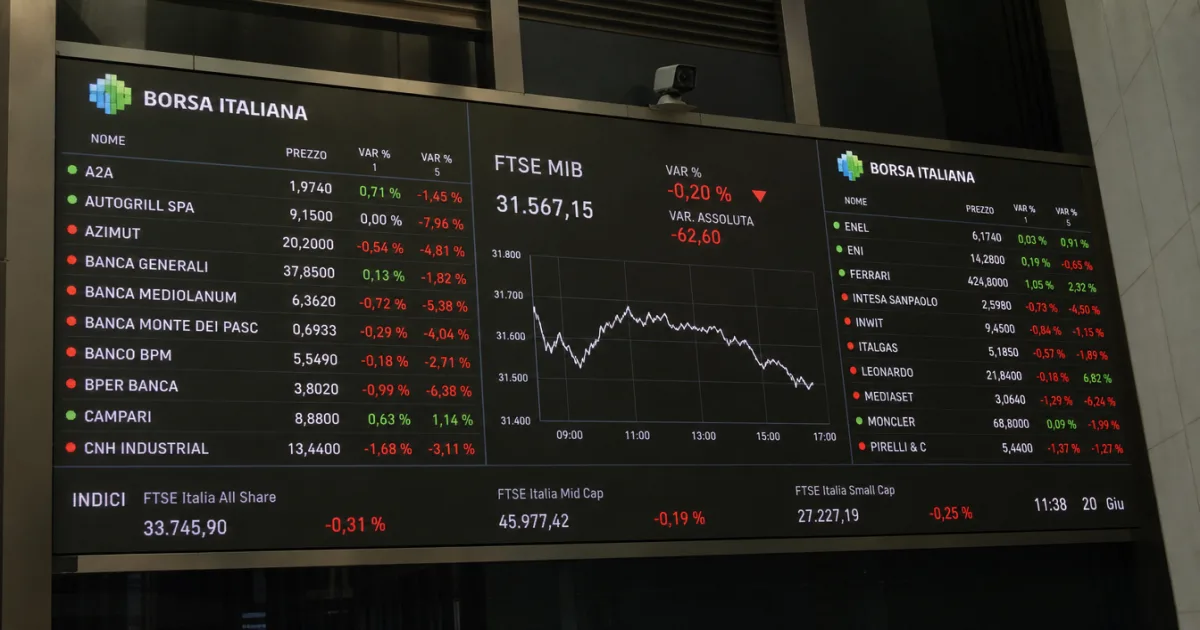
\nIn Italy, the main equity market is Piazza Affari in Milan, with its benchmark index, the FTSE MIB, tracking the 40 most important listed companies. As of early 2026, it was trading around 44,000 points — significantly higher than the 20,000 points it touched in October 2022, showing how markets can recover and grow over the medium term despite turbulence.
\nFinancial markets play a critical role in the economy: they let businesses raise capital to grow, and give savers a way to put their money to work. Without them, companies would rely entirely on banks for funding, and you’d have very few alternatives to a mattress for your savings.
\nThe main financial instruments: stocks, bonds, mutual funds, ETFs
\nYou don’t need to know all of them. But understanding the difference between the four most common ones gives you a real advantage.
\nStocks. Buying a stock means becoming a part-owner of a company. If the company does well, the stock’s value rises and you may receive dividends. If it struggles, the value falls. Stocks offer the highest potential returns — but also the most volatility. A 20–30% swing in a single year isn’t unusual.
\nBonds. These work like loans: you lend money to a company or government and receive periodic interest payments plus your principal back at maturity. The risk is generally lower than stocks, but so is the return. Italian government bonds — BTP (Italian government bonds, Buoni del Tesoro Poliennali) — are a common example.
\nMutual funds. A professional manager pools money from many investors and invests it according to a defined strategy. The advantages are diversification and professional management. The drawback: fees. In Italy they can reach 2–3% per year, which quietly erodes a significant portion of your returns.
\nETFs (Exchange Traded Funds). Similar to mutual funds, with one crucial difference: they passively track a market index rather than having a manager picking stocks. The result? Much lower costs — often 0.1–0.5% per year — and, according to numerous studies, returns that beat most actively managed funds over the long run. Our dedicated ETF guide goes deeper if you want to explore.
\nHow to start managing your finances
\nHere’s a concrete five-step path.
\nStep one: take stock of where you stand. Get a spreadsheet and write down what you earn and what you spend each month. Be honest — include the daily coffee and the streaming subscriptions you forgot to cancel. This exercise alone is revealing.
\nStep two: build an emergency fund. Before thinking about investments or complex strategies, set aside three to six months of fixed expenses. Keep it somewhere accessible (a flexible savings account works fine) and touch it only for genuine emergencies.
\nStep three: eliminate expensive debt. If you have loans charging more than 5–6% — revolving credit cards, consumer loans — paying them off is the best “investment” you can make. No market reliably delivers returns equal to the 15–20% you’re paying on revolving debt.
\nStep four: start investing, even small amounts. You don’t need large capital. With a recurring investment plan (PAC), you can start with €50–€100 a month in a diversified ETF. What matters is starting early: time is the investor’s greatest ally because of compound interest. Investing €100 a month at a 7% average annual return — the historical average for global equity markets — leaves you with roughly €120,000 after 30 years. Of that, you contributed only €36,000. Time does the rest.
\nStep five: keep learning. Financial education isn’t a destination — it’s a journey. Italy ranks 36th out of 39 OECD countries for adult financial literacy. That’s not discouraging — it means your margin for improvement is enormous.
\nThis article describes Italian regulations and financial products. Information is provided for educational purposes and does not constitute financial, tax, or legal advice. Rules and figures refer to the Italian regulatory framework as of the publication date and may change.