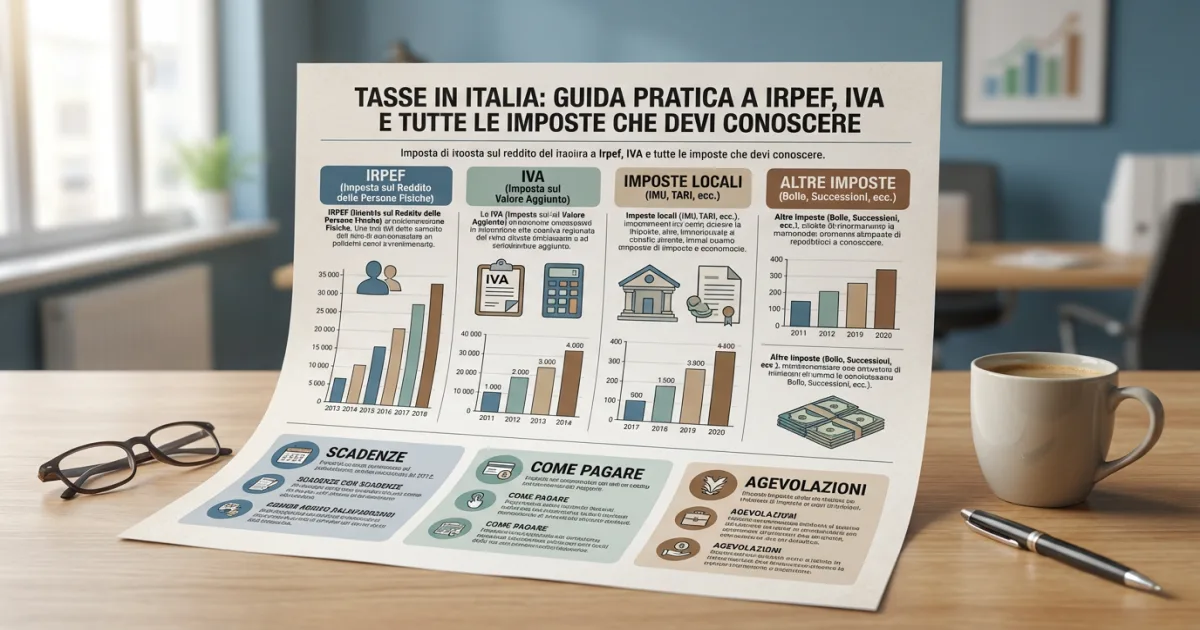
Every year the same question comes up: how much do I actually pay in taxes? The answer is never simple — in Italy, taxes aren’t a single item. They’re a stack of levies that pile up, overlap, and are rarely explained clearly.
This guide isn’t written for accountants. It’s written for you — someone who gets a payslip, files a tax return once a year, and wants to understand where your money goes. And how to make sure some of it stays.
How the Italian Tax System Actually Works
Italy runs a “progressive” tax system: the more you earn, the higher the rate you pay. In theory, that’s fair. In practice, it works through income brackets — each chunk of your income taxed at a different rate.
But income taxes are just the start. There’s also a consumption tax (VAT), a property tax (IMU), local surcharges that vary by municipality, and a series of additional levies that most people only discover after filing.
The main body handling all of this is the Italian Revenue Agency (Agenzia delle Entrate) — the institution you deal with every time you file a return or make a payment via the F24 form (Italy’s unified tax payment slip).
IRPEF: Current Brackets and Rates
IRPEF (Italy’s personal income tax) is the most significant tax for anyone working in Italy, whether as an employee or self-employed.
It works in brackets: each portion of your income is taxed at a different rate. It’s not your total income that gets hit with the highest rate — only the slice above each threshold.
For 2026, the IRPEF tax brackets are:
| Annual income | Rate |
|---|---|
| Up to €28,000 | 23% |
| €28,001 to €50,000 | 35% |
| Above €50,000 | 43% |
A concrete example: if your gross annual income is €35,000, you don’t pay 35% on all of it. You pay 23% on the first €28,000 (= €6,440) and 35% on the remaining €7,000 (= €2,450). Gross IRPEF: €8,890.
Then come the employee tax credits, which reduce the effective tax. The result: a salaried employee earning €35,000 typically ends up paying an effective average rate of 22–25% — less than most people expect, but still a meaningful number.
If you’re an employee, your employer withholds IRPEF directly from your payslip every month, acting as a tax withholding agent. If you’re self-employed or have other income sources, you handle it through your tax return.
VAT: How It Works and Who Really Pays It
Every time you buy something — at the supermarket, online, from a mechanic — you’re paying VAT (Value Added Tax, called IVA in Italy). It’s already built into the price you see; it doesn’t get added afterward.
The standard rate is 22%, but reduced rates apply to certain categories:
- 4% on basic necessities: bread, milk, school textbooks, infant products
- 10% on certain foods, hospitality services, and building renovations
- 22% on everything else
Who really pays it? You — the final consumer. Businesses collect it and pass it to the government, but the cost lands on whoever buys. If you hold a VAT number (partita IVA) as a self-employed professional, you can deduct the VAT on business purchases: that’s the mechanism that prevents it from being charged multiple times along the supply chain.
IRAP, IMU, and Other Italian Taxes
Beyond IRPEF and VAT, the Italian tax landscape includes other levies that may apply to you depending on your situation.
IRAP (Italy’s regional production tax) mainly hits businesses and professionals with an organized structure. It’s calculated on the “value of production” — what the business generates, not just its profit. The base rate is 3.9%, but each region can adjust it. Since 2022, self-employed workers without employees are exempt — but if you run a company or a structured practice, it still applies.
IMU (Italy’s municipal property tax) is levied on real estate. If you own a second property, an office, or an industrial unit, you pay it every year in two installments: advance payment due June 16 and balance due December 16. A primary residence is exempt — unless it falls into a “luxury” cadastral category (A/1, A/8, A/9).
The calculation: revalued cadastral value × municipal rate. Each municipality sets its own rate within legal limits, so what you pay depends partly on where the property is located.
TARI (Italy’s waste-collection tax) is paid by almost everyone — owners and tenants alike, depending on the rental contract. It’s calculated on floor area and the number of occupants.
Regional and Municipal Surcharges: The Hidden Cost
Many people don’t think about it until they look at their tax return summary: on top of national IRPEF, there are two additional levies — the regional surcharge and the municipal surcharge — both calculated on your taxable income.
The regional surcharge ranges from 1.23% to roughly 3.33% depending on where you live. Calabria and Campania apply the highest rates; some northern regions stay at the minimum.
The municipal surcharge runs from zero (some municipalities don’t levy it) up to 0.8% of taxable income. Small percentage, but on a €35,000 income it can add up to €200–€280 per year.
Both are paid alongside IRPEF in installments or through your tax return. They don’t get much publicity, but they have a real impact on your total tax burden.
Deductions and Tax Credits: Legally Cutting Your Bill
This is where personal tax management gets interesting. Italy gives you two distinct tools to reduce what you owe:
Deductions lower your taxable income — the base on which the tax is calculated. Typical examples: voluntary pension contributions, donations to certain nonprofits, contributions for domestic helpers.
Tax credits reduce the tax already calculated. They’re more common and more direct. The main ones:
- Medical expenses: 19% tax credit on the portion above €129.11. If you paid €1,000 in specialist visits, you get roughly €166 off your tax bill.
- Interest on a primary-residence mortgage: 19% credit, up to €4,000 in annual interest (max €760 in savings).
- Building renovations: 50% credit, spread over 10 years. On €10,000 in works, you recover €5,000 over a decade (€500 per year).
- Dependent-children expenses: available up to age 25 under certain income and study conditions.
- Young renters’ credit (under 31): €991.60 credit for those renting their first home outside the family household.
The rule that catches people off guard: expenses must be paid by traceable means (bank transfer, debit/credit card, payment app). Cash payments for creditable expenses don’t qualify.
The Tax Calendar: Key Deadlines
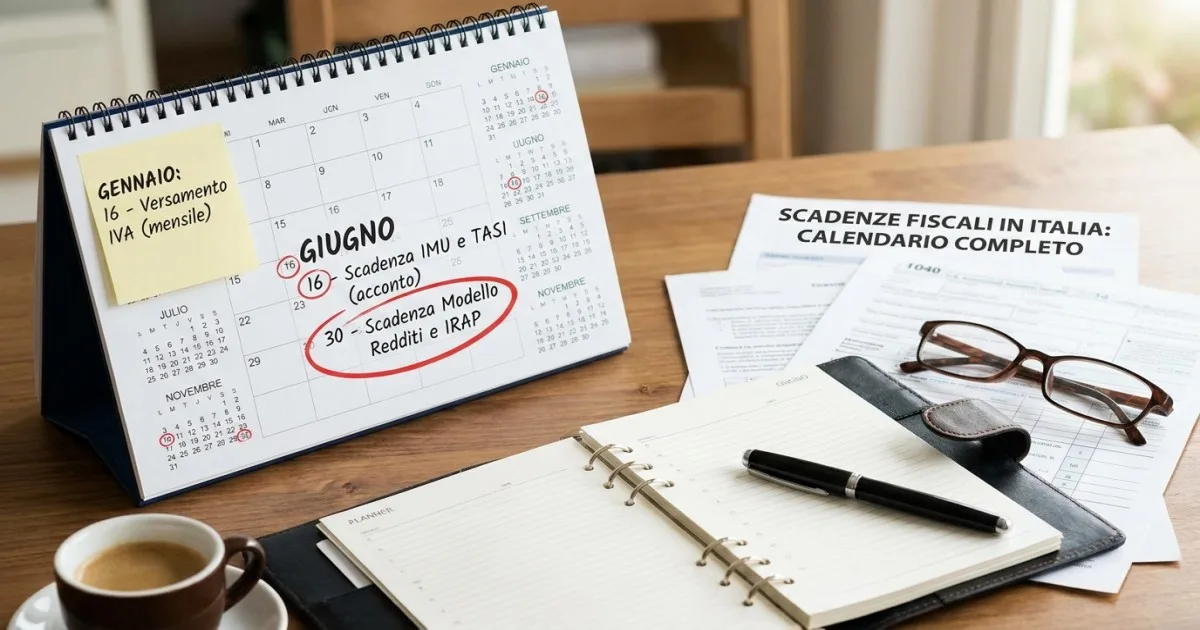
Missing a tax deadline gets expensive fast — interest and penalties stack up. These are the dates to track every year:
January–April
- CU (Italy’s annual income certificate): your employer or client sends it by March. It documents your prior-year income. Keep it — you need it when you file.
May–July
- Pre-filled 730 tax form: available on the Revenue Agency website from May. If your only income is employment, you can often accept it as-is or make minor changes. Filing deadline: late September (via a CAF tax assistance center or accountant) or September if filing independently.
- IMU advance payment: June 16
November–December
- IMU balance payment: December 16
- Second IRPEF advance payment (for self-employed and those with outstanding tax): November 30
If you miss a deadline, Italy has a voluntary tax regularization procedure called ravvedimento operoso: you pay with a small surcharge (reduced penalty plus interest) within set timeframes, and the situation is resolved without serious consequences.
Practical Tips for Managing Your Taxes
You don’t need to be an expert. A few concrete habits make a real difference.
Keep records during the year. Medical receipts, renovation invoices, pharmacy receipts: store them in a folder — digital works fine. When May comes and you open your pre-filled return, everything will be at hand.
Pay creditable expenses by traceable means. Paying the dentist in cash disqualifies the credit. Card or bank transfer keeps it.
Check the pre-filled return before accepting it. The Revenue Agency does solid work, but things can be missing — a medical expense not reported, a recently opened mortgage. Five minutes of review is worth it.
If your situation is complex, invest in a good accountant. It’s not a cost — it’s an investment. They often save far more than their fee. And their fee itself qualifies as a creditable expense.
Taxes will never be fun, but understanding how they work makes a real difference — not just to avoid mistakes, but to use every legal opportunity to pay less. The tax office takes what it’s owed. Don’t give it more than that.
This article describes Italian regulations and financial products. Information is provided for educational purposes and does not constitute financial, tax, or legal advice. Rules and figures refer to the Italian regulatory framework as of the publication date and may change.