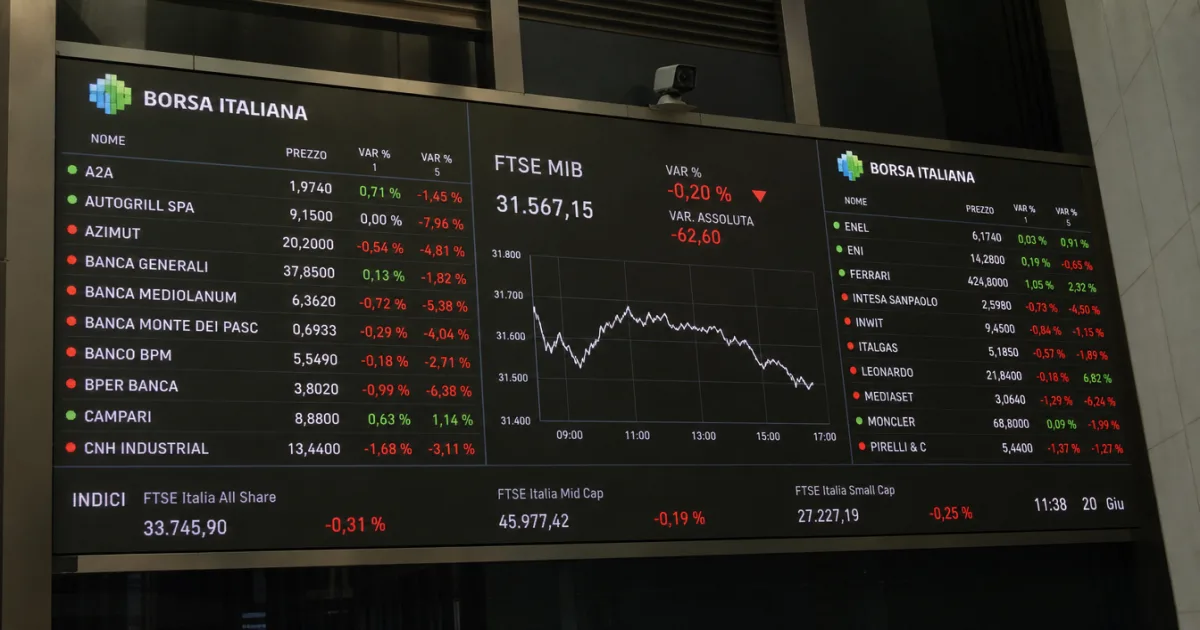
Most Italians don’t know how much they spend each month, have no emergency fund, and only discover compound interest when they’re already in debt. That’s not their fault — nobody taught them. Financial education isn’t just for the wealthy or for traders. It applies to anyone with a bank account, a salary, or rent to pay. Understanding how money works is the most practical decision you can make today.
Why nobody teaches us to manage money
Italy ranks among the lowest in Europe for financial literacy. According to data from the Bank of Italy (in Italian), fewer than 30% of Italian adults can correctly answer basic questions about inflation, interest rates, and risk diversification. The comparison with Northern Europe is stark.
School doesn’t help. The Italian curriculum covers math, history, and Latin — but not a word about how to file a tax return or what a variable-rate mortgage means in practice. This gap isn’t accidental: for decades, money management was treated as a private family matter. But if nobody in the family knows how to invest, the gap persists.
The result is generations facing the biggest financial decisions of their lives — buying a home, opening a business as a self-employed VAT holder, choosing a pension fund — without the right tools. And often ending up in the hands of people who benefit from keeping them in the dark.
What financial education actually means
Financial education isn’t knowing how to trade stocks. It’s not being obsessed with frugality or giving up every pleasure to accumulate wealth. It’s something simpler and more concrete: understanding how money works in your daily life so you can make better decisions.
It means knowing your real balance at the end of the month — not the nominal one you see in your banking app. It means understanding why a loan at 15% annual percentage rate (APR / TAEG) is a trap and one at 3% can be reasonable. It means telling apart a useful insurance policy from one sold to pad a financial advisor’s commission.
In our experience, people who improve their financial education don’t necessarily get richer overnight — but they stop losing money through ignorance. Over the long run, that’s worth a great deal.
The 5 fundamental concepts everyone should know
You don’t need years of study. Five concepts, genuinely understood, change how you manage money.
1. Compound interest
This is the mechanism by which interest earns interest on previous interest. On a €10,000 deposit at 5% per year, after 20 years you don’t have €20,000 — you have roughly €26,500. It works in your favor when you invest, against you when you’re in debt. Einstein reportedly called it “the eighth wonder of the world.” Perhaps an exaggeration, but the concept holds.
2. Inflation
Money sitting still loses value. At 2% annual inflation, €10,000 kept under the mattress is worth about €8,200 in real terms after ten years. Every time you hear “I keep everything in a checking account because it’s safer” — this is the answer.
3. Risk and diversification
There’s no return without risk. But risk can be managed by spreading investments across different assets: stocks, bonds, different geographic markets. Putting everything on a single stock or a single cryptocurrency isn’t investing — it’s gambling.
4. APR (annual percentage rate / TAEG)
This is the real cost of a loan, including interest, fees, and ancillary charges. Two loans with the same nominal rate can have very different APRs. Before signing any credit contract, look at this number — not the nominal rate advertised in large print.
5. The difference between assets and liabilities
An asset puts money in your pocket each month (rental income, a dividend). A liability takes it out (car payments, a mortgage). Good financial management means growing your assets and keeping liabilities in check — not eliminating them, but understanding which ones are genuinely worth their cost.
Personal budget: the concrete first step
Before talking about investments, pension funds, or cryptocurrencies, there’s a step zero that almost everyone skips: knowing where your money goes. A personal budget isn’t a complicated spreadsheet — it’s the answer to a simple question: at the end of the month, where did my salary go?
The most widely used method is 50/30/20: 50% of take-home pay for fixed needs (rent, utilities, groceries), 30% for wants (restaurants, subscriptions, travel), 20% for saving and investing. On a net salary of €2,000, that’s €1,000 for fixed costs, €600 for discretionary spending, and €400 to set aside each month.
In practice in Italy, with sky-high rents in major cities, the 50% for fixed costs often isn’t enough. The model needs adapting. But the principle holds: the savings slice comes out first — moved aside the moment the salary arrives, not from what’s left over. If you wait for “what’s left at month-end,” there’s usually nothing left.
Our personal budget guide covers practical methods and free tools to build one that actually sticks.
Emergency fund: how much to set aside
The emergency fund is the foundation of any sensible financial plan. It’s a cash reserve, kept in an easily accessible account, that covers unexpected expenses without forcing you to take on debt or sell investments at the wrong moment.
The standard rule is three to six months of monthly expenses. If your fixed costs total €1,500 a month, your emergency fund should sit between €4,500 and €9,000. For the self-employed, with less stable income, aim for six to twelve months.
Where to keep it? Not in the checking account you use for daily expenses — the temptation to dip in is too high. A flexible-withdrawal savings account yielding even 1–2% is enough: the goal is to preserve capital and beat inflation, not maximize returns. The emergency fund isn’t an investment — it’s insurance.
Common financial mistakes (and how to avoid them)
A mistake we often see is confusing income with wealth. Earning well doesn’t mean being financially solid — if everything that comes in is gone by month-end, a high salary builds nothing. A doctor earning €5,000 net a month with a maxed-out mortgage, two car payments, and zero savings is financially more vulnerable than a teacher who sets aside €400 a month for twenty years.
The second classic mistake is procrastinating. “I’ll start saving when I earn more.” But with a recurring investment plan (PAC) of €100 a month in a global ETF starting at 25 — assuming a historical average return of 7% per year — you reach roughly €264,000 by 65. Start at 35 with the same monthly amount and you get €121,000. Ten years of delay costs €143,000.
There’s also the problem of invisible spending: forgotten subscriptions, unmonitored bank fees, overlapping insurance policies. Reviewing twelve months of bank statements almost always turns up expenses you weren’t aware of — often €50 to €150 a month. Small numbers that add up to €600–€1,800 a year.
Free resources to learn: books, podcasts, and sites
You don’t need paid courses or expensive consultants to get started. There are excellent resources, some in English, completely free.
| Type | Resource | Best for |
|---|---|---|
| Book | The Little Book of Common Sense Investing — John C. Bogle | Understanding ETFs and index funds |
| Book | Rich Dad Poor Dad — Robert Kiyosaki | Beginners: reframes how you think about money |
| Podcast | Planet Money (NPR) | Engaging finance stories in plain English |
| Institutional site | EducazioneFinanziaria.it (Bank of Italy) (in Italian) | Solid foundations, verified, free |
| Site | BancaFinanza.it | Practical guides on investing, taxes, and banking in Italy |
One warning: be skeptical of anyone promising guaranteed returns, “exclusive” courses for thousands of euros, or secret strategies “banks don’t want you to know.” Serious financial education is boring in the best sense — it works slowly, steadily, without shortcuts.
Teaching financial education to children
Money habits in families are often passed on by osmosis — children absorb their parents’ patterns, good or bad. Adding a few concrete tools shifts the trajectory.
With young children (ages 6–10), a weekly allowance is the first financial lab: it introduces the concept of a limited budget and trade-offs. The amount doesn’t matter — even €2–€3 a week is enough. What matters is that it’s regular and the child decides how to use it.
From around 12 onward, introduce the idea of saving toward a specific goal: “if you put aside half your allowance for three months, you can buy that thing you want.” This teaches delayed gratification — one of the most predictive traits of long-term financial well-being, according to decades of longitudinal research.
With teenagers, go further: open a bank account in their name (with supervision), explain what a bank transfer is, what a bank statement shows, what an interest rate means. No structured course needed — just normal conversations about household finances, without taboo. Families that talk openly about money produce more financially aware children. The data on this are fairly clear, even if the topic remains culturally uncomfortable in Italy.
If you’re ready to take a first concrete step, our guide on what finance is and how it works is a solid place to build from.
Don’t wait until you “know more” to start. Open a spreadsheet, write down last month’s income and expenses, set aside your first month of savings as an emergency fund. These three actions — simple, concrete, doable this week — are worth more than any €500 course.
This article describes Italian regulations and financial products. Information is provided for educational purposes and does not constitute financial, tax, or legal advice. Rules and figures refer to the Italian regulatory framework as of the publication date and may change.