Investing in Meta Platforms stock in 2026 means betting on one of the most profitable advertising machines in the world, now in the middle of a transformation toward artificial intelligence. With a market cap of around $1.7 trillion and digital advertising revenue forecast to surpass Alphabet's in 2026, the META ticker remains one of the most watched by investors — including Italians. But buying Meta shares is not a straightforward decision: between a 26% capital gains tax, market valuations, AI infrastructure costs and announced layoffs, every detail needs weighing before putting capital at risk.
\n\nMeta Platforms today: figures, positioning, ecosystem
\n\nMeta Platforms — formerly Facebook — now controls a digital ecosystem that includes Facebook, Instagram, WhatsApp, Messenger and the Quest headsets. But the financial picture only tells half the story: the real engine remains advertising revenue, which accounts for more than 95% of the group's turnover.
\n\nIn Q4 2025 Meta reported revenue of $59.89 billion and net income of $22.77 billion, with an operating margin above 41%. For Q1 2026, analyst consensus sits at revenue of $53.5–56.5 billion and EPS of around $6.74. These are not ordinary numbers: compared to most publicly listed companies in the world, they make Meta one of the most liquid and profitable companies on the Nasdaq.
\n\nThe 2026 global advertising revenue projections put Meta at $243 billion against Google's $239 billion — a historic overturn in digital advertising that was unthinkable three years ago. It is one of the reasons analyst sentiment remains solidly bullish: 60 buy recommendations out of 67 coverage ratings, with an average price target around $855.
\n\nMarket cap and positioning within the Magnificent Seven
\n\nWith a market cap of $1.71 trillion, Meta is the fourth-largest stock in the Magnificent Seven group (the seven big-tech names that dominate the S&P 500), behind Apple, Microsoft and Alphabet. It accounts for roughly 4% of the S&P 500 index — a weight that makes it practically impossible to ignore for anyone investing in global ETFs.
\n\nPrice and valuation: P/E as a compass
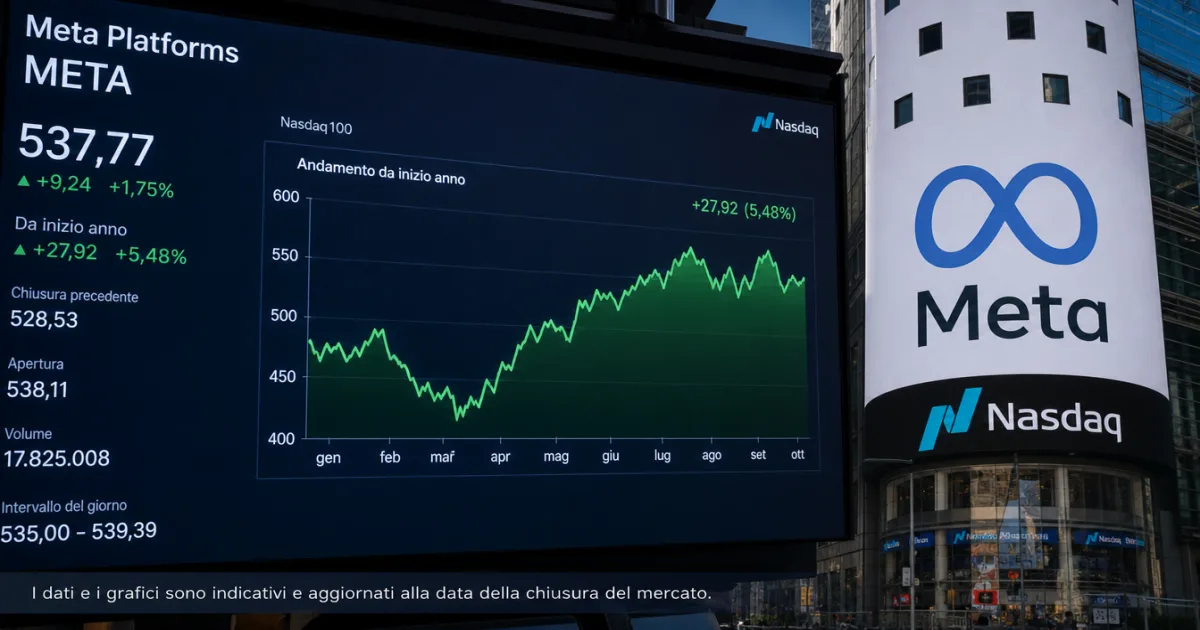
\n\nThe META share price in 2026 oscillates between $675 and $690, with a 52-week range of $479–$796. The more important figure for anyone evaluating an investment, however, is the price-to-earnings (P/E) ratio: it currently stands at around 28–29x trailing twelve-month earnings, and roughly 22x estimated 2026 earnings.
\n\nIn plain terms: Meta is not a bargain, but it is not in bubble territory either. For a quick comparison, here is where the big-tech names sit on valuation multiples and growth.
\n\n| Company | \nP/E (TTM) | \nMarket Cap | \nRevenue growth YoY | \n
|---|---|---|---|
| Meta Platforms | \n~28 | \n$1.71 T | \n+21% | \n
| Alphabet | \n~26 | \n$4.22 T | \n+15% | \n
| Microsoft | \n~36 | \n~$3.5 T | \n+13% | \n
| Amazon | \n~42 | \n~$2.3 T | \n+11% | \n
Compared to direct competitors, Meta strikes a good balance between growth and price. Microsoft and Amazon trade at higher multiples; Alphabet is slightly cheaper but growing more slowly. For anyone buying today, there is a margin of safety — as long as you are not expecting 2026 earnings to double in two years.
\n\nThe real risks every investor needs to know
\n\nBuying META at today's price comes with three specific risks that deserve careful attention. These are not technicalities: they are things that can move the price by 10% in a single day.
\n\nOff-the-charts AI capex
\n\nMeta has announced capital expenditure of $115–135 billion for 2026 — almost double the 2024 level. The funds are needed to build data centres, buy Nvidia GPUs and hire talent for Llama (Meta's in-house AI model). This is money spent before the corresponding revenue materialises. The market appreciates the vision, but fears short-term margin erosion.
\n\nEuropean regulatory pressure
\n\nThe EU's Digital Markets Act and Digital Services Act continue to tighten the grip on Meta's advertising practices. Fines, data-use restrictions and mandatory business-model changes are not remote scenarios: the company has already received billion-dollar penalties from the EU antitrust authorities. For an Italian investor, this is a factor to consider with extra care, because it directly affects the European market where Meta generates roughly 25% of its revenue.
\n\nLayoffs and internal tensions
\n\nMeta announced a new round of layoffs starting 20 May 2026, affecting roughly 10% of its workforce — around 8,000 employees. Historically, Meta's headcount reductions have sent the stock higher (investors like efficiency). But there is a flipside: the cuts also affect AI divisions considered strategic, which could slow key projects. Our reading: positive for the short-term income statement, but worth monitoring over the medium term.
\n\nHow to buy Meta shares from Italy
\n\nMeta Platforms shares are listed on the Nasdaq with the ticker META. Italian investors have three main options.
\n\nThe first is a traditional broker (Fineco, Directa, Banca Sella, Webank): higher fees, but MiFID protection, automatic tax reporting and integrated reporting for the 730 tax form. The second option is a specialist online broker (DEGIRO, Trade Republic, Interactive Brokers): minimal commissions, often under €2 per order, but in many cases you need to file the RW section yourself for the asset-monitoring declaration. The third option is to buy an ETF that holds Meta — a far more diversified approach, which we covered in our investment strategies guide.
\n\nThe currency factor that people often forget
\n\nOne aspect many Italian investors overlook: buying META means buying dollars, not euros. If the dollar strengthens 10% against the euro while the stock rises 5%, your actual gain is 15%. If it weakens 10%, the gain disappears. In 2026 the EUR/USD exchange rate moves in a range that can cut or add 5–8% to annual returns — not marginal.
\n\nCapital gains tax in Italy: the concrete numbers
\n\nThis is where many Italian investors make costly mistakes. Capital gains on shares like Meta are subject to a 26% substitute tax. No brackets, no progressivity: sell at a profit, pay €26 on every €100 of capital gain.
\n\nHere is a practical example. You buy 10 Meta shares at $600 each: total $6,000. You sell them a year later at $750 each: proceeds $7,500. Capital gain: $1,500. Tax: $1,500 × 26% = $390. Net gain: $1,110. It sounds simple, but watch out: the capital gain is calculated by converting both the purchase and sale prices into euros at the ECB exchange rate on each day. The Italian Revenue Agency (Agenzia delle Entrate) wants the calculation in euros, not dollars.
\n\nIf you use an Italian broker acting as withholding agent, the tax is applied automatically — no RW section, no year-end calculations. If you use a foreign broker (DEGIRO, Trade Republic, Interactive Brokers), you must file the RW section for the asset-monitoring declaration and pay IVAFE (a tax on foreign financial assets, 0.2% of the value). The RW section is completed using annual average values, and it is one of the areas where the Italian Revenue Agency most frequently runs checks.
\n\nFor dividends (Meta has paid $0.52 per share per quarter since 2024, giving a trivial yield of around 0.3%), the treatment is the same: 26% substitute tax. A 15% withholding is also applied in the US (under the Italy–US double-taxation convention), but it can be credited in your tax return.
\n\nPractical strategies for investors looking to build a position
\n\nThree approaches make sense for an Italian investor in 2026, each with its own risk profile.
\n\nThe first is a recurring investment plan (PAC, Piano di Accumulo del Capitale): investing a fixed amount each month — say €200 — regardless of the price. It reduces the risk of buying at the top and builds long-term discipline. It works well with Meta because the stock is highly volatile but has a structurally positive trend. Several brokers now offer PAC on individual stocks with zero commissions.
\n\nThe second is lump-sum investing on dips: waiting for a 15–20% correction (which happened twice in 2025) and buying at those moments. It works if you have discipline and cash set aside. It does not work if you try to “pick the bottom”: typically you buy while the stock is still falling another 5–10%.
\n\nThe third — and in our view the most sensible for beginners — is to buy an MSCI World or S&P 500 ETF: Meta is inside for roughly 4%, alongside the other big-tech names, and the specific risk of the individual stock is diluted. When thinking about portfolio construction, this is the most sensible solution for most Italian savers. Our dedicated ETF guide covers this in detail.
\n\nWhat to expect over the next few quarters
\n\nOn 29 April 2026 Meta reported Q1 results, alongside Microsoft, Alphabet and Amazon. Investors watch three things: the resilience of advertising revenue (Reels and WhatsApp Business in particular), the update on AI capex (whether estimates are confirmed or raised), and the impact of the announced layoffs.
\n\nFor 2026 as a whole, analysts estimate Meta profits at $75.9 billion (+27% on 2025) on revenue of $235 billion (+18%). These are ambitious but achievable numbers if AI starts generating tangible revenue — not just through advertising targeting, but also through consumer products such as Meta AI integrated into WhatsApp chats and Quest headsets.
\n\nThe most concrete downside risk remains a US recession: in that scenario, the advertising budgets of Meta's corporate clients contract first, and Meta suffers more than Microsoft or Apple. Anyone buying today should have a time horizon of at least 3–5 years and should not check the price every day.
\n\nMeta vs Alphabet: the battle of the next few years
\n\nFor years Alphabet (Google) was the undisputed reference in digital advertising. By 2026 the gap has narrowed to almost nothing. Understanding how the two giants differ helps decide which to back — or whether to hold both.
\n\nMeta's edge is a more “social” app ecosystem and a finer-grained targeting capability thanks to the behavioural signals collected across Instagram, Facebook and WhatsApp. Alphabet has search, YouTube, Android and a cloud business growing at over 50% annually. On the AI front, Meta has chosen the open-source route (Llama is free and modifiable); Alphabet has chosen the proprietary one (Gemini is closed). They are two different strategies: the first builds ecosystem rapidly but monetises less in the short term; the second monetises immediately but risks faster obsolescence.
\n\nFor a balanced portfolio in 2026, holding both — perhaps through a Nasdaq 100 ETF — reduces the risk of backing the wrong winner. If you really must choose, Meta has a more attractive P/E and slightly higher revenue growth. But valuations change quickly: what looks interesting at 22x earnings may not at 28x.
\n\nReality Labs: the dead weight that could become an asset
\n\nReality Labs, the metaverse and headset division, deserves a section of its own. Over the past three years it has burned through more than $50 billion, posting recurring quarterly losses. The market has largely priced this in negatively, treating it as a “Zuckerberg tax” on advertising profits.
\n\nThe reality is more nuanced: Quest 3 headsets are selling well in professional markets (training, design, healthcare), and Ray-Ban Meta — the AI-integrated smart glasses — exceeded one million units sold in 2025. These are not revolution-scale numbers, but they are beginning to justify the investment. For a long-term investor, Reality Labs is the classic moonshot that could end up worthless or become the next iPhone of its category.
\n\nFinal thoughts for the Italian investor
\n\nMeta combines growth and value characteristics: it is still growing at double-digit rates but generated over $60 billion in free cash flow in the past twelve months. Few companies anywhere in the world can match those numbers. The question is not whether Meta is a good company — it is — but whether entering at today's price makes sense for your specific profile.
\n\nIf you already have significant big-tech exposure through ETFs, adding individual Meta shares concentrates risk in a way that is not always rational. If, on the other hand, your portfolio consists only of BTP (Italian government bonds, Buoni del Tesoro Poliennali) and bond funds, a small position (5–10% of the portfolio) in a stock like Meta can meaningfully improve the risk-return profile. As always, the overall asset allocation matters more than the individual stock you choose.
\n\nThe real decision is not “Meta yes or Meta no.” It is understanding whether you need more equity exposure, and in what form. Once you have answered that, choosing a specific stock becomes a much simpler exercise.