“High-return investments” is one of the most-searched terms in Italy — and one of the most dangerous for savers' portfolios. In 2026, CONSOB (Italy's securities-market regulator) had already blocked over 1,650 abusive financial websites promising guaranteed double-digit returns, while the Polizia Postale recorded roughly €145 million stolen from Italians through fake online trading in a single year. Real high returns exist, but they do not work the way Instagram adverts suggest. Here is what the regulated financial market actually offers, where the real opportunities are, and how to tell an aggressive investment from a scam with a predictable script.
The rule no advertisement ever shows
In finance there is a mathematical principle, not an opinion: return and risk are coupled. Every extra euro of return comes at the cost of an extra unit of risk. When someone offers “high returns with low risk,” they are not presenting a financial discovery: they are lying, or they do not understand what they are selling.
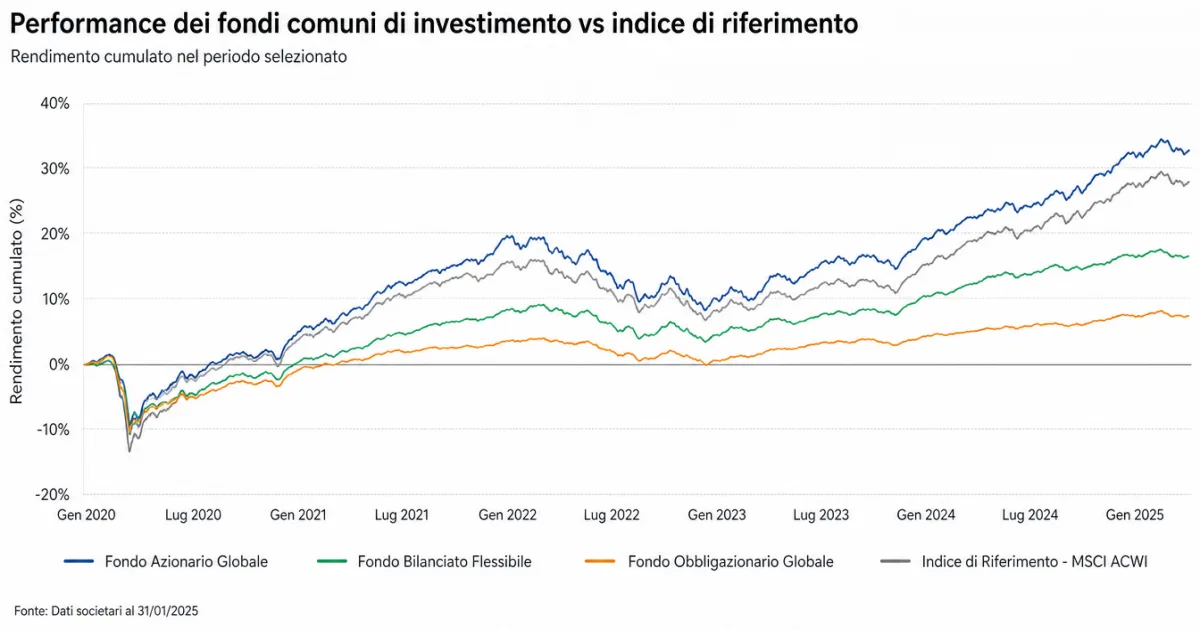
Historical market data confirm the rule with precision. Over the past 50 years, 10-year US Treasuries returned an average of 4% gross annually with volatility of 6–8%. The S&P 500 returned 8–10% with volatility of 16–20%. Cryptocurrencies (Bitcoin) returned 35–40% with volatility above 70%. The higher the expected return, the lower the stability: in some years you gain a lot, in others you lose just as much.
“High return” does not mean “easy return” or “certain return.” It means accepting significant swings, a real possibility of partial or total capital loss, and long time horizons. Anyone who promises otherwise is offering something else entirely.
What the regulated market actually offers in 2026
To give a concrete map of the assets available to anyone seeking higher returns, here are the four main groups of instruments that can potentially generate above-average income — along with the corresponding risks.
| Asset class | Expected gross annual return | Typical volatility | Maximum historical drawdown |
|---|---|---|---|
| Global equities (MSCI World) | 7–9% | 15–18% | −55% (2008) |
| Emerging markets | 8–11% | 20–25% | −65% |
| High yield bonds | 5–8% | 8–12% | −35% |
| Small-cap value | 9–12% | 22–28% | −60% |
| Private equity (funds) | 10–14% | variable | −50%, years of illiquidity |
| Cryptocurrencies (Bitcoin) | 15–25% (historical) | 60–80% | −85% (2018, 2022) |
Maximum drawdown is the figure few people look at, and the one that should come first. It is the largest peak-to-trough loss that asset has historically recorded. It means: if you had invested €10,000 in global equities at the 2007 peak, after eighteen months you would have had €4,500. You would have needed to wait five years just to break even. Anyone who cannot handle this psychologically will sell at the bottom and lock in the loss.
The four real categories of high returns
Here is a detailed look at where the highest returns in the regulated market can be found today.
Emerging-market and thematic equities
Emerging markets (China, India, Brazil, Vietnam, Indonesia) have historically offered higher potential returns than the MSCI World, in exchange for greater volatility and country-specific risks. ETFs such as iShares MSCI Emerging Markets, Vanguard Emerging Markets or India-focused products (LYXOR MSCI India) are accessible with TERs between 0.18% and 0.55%. A small allocation (10–20% of the portfolio) can increase expected returns without over-exposing to swings.
Thematic ETFs (artificial intelligence, renewable energy, biotech, semiconductors) have had periods of spectacular returns but also corrections of 40–60%. They are speculative products that let you bet on a sector's rise: when the theme falls out of favour, the price falls sharply.
High yield bonds and subordinated debt
High yield bonds (sub-investment-grade rated, BB and below) are returning 5–8% gross annually in 2026, against 2.5–3.5% for European government bonds. The higher return compensates for the issuer's default risk: in recessions, the insolvency rate on high yield can exceed 5–7%, with significant losses. ETFs such as iShares Global High Yield Corp (TER 0.50%) or Xtrackers EUR High Yield (0.35%) provide diversification across hundreds of issuers.
Private equity and venture capital
For qualified investors with long time horizons, private equity funds have historically returned 10–14% gross annually. Access is reserved for professional or private-banking clients, with typical minimum investments of €100,000 or more. The main constraint: capital is locked up for 7–10 years. This is not an investment for anyone who needs to liquidate in an emergency.
Cryptocurrencies
Bitcoin and Ethereum became a recognised asset class in 2024, following the SEC's approval of spot ETFs in the US and the entry into force of the MiCAR regulation in Europe. Historically, returns have been extremely high (Bitcoin returned over 200% in 2024), but losses have also been extreme (−85% in 2018, −75% in 2022). For a cautious investor, a small allocation (1–5% of assets) through regulated ETFs/ETCs may make sense as diversification — never as a primary investment.
How “guaranteed high-return” scams work
In the first four months of 2026, CONSOB had already blocked dozens of new abusive sites. The script is always the same. Recognising it is the first line of defence.
It starts with a sponsored ad on Facebook, Instagram, YouTube or TikTok. It often uses the face of a well-known figure (entrepreneur, TV presenter, politician) modified with AI to claim they have “discovered a guaranteed profit system.” The “Renditix AI” case, dismantled by CONSOB on 19 March 2026, followed exactly this pattern: a site presenting itself as an AI-based trading platform, with Facebook profiles exploiting the images of Italian institutional figures.
Clicking leads to a polished landing page with fictitious profit charts, invented testimonials and fake logos of banks and regulators. You fill in a form with your name, phone number and email. From that moment insistent phone calls begin: a self-proclaimed “advisor” guides the victim through opening an account and making first deposits — usually small, €250–500.
The psychological game is sophisticated. In the first few days, the platform shows “profits” (it is just an interface controlled by the fraudsters, not a real market). The victim is convinced and deposits more. When they try to withdraw, the problems start: “you need to pay taxes in advance,” “you need to provide a guarantee,” “the withdrawal is blocked for anti-money-laundering checks.” Every withdrawal request becomes a new deposit request. When the victim stops paying, the site disappears.
The numbers reveal the scale of the phenomenon. Out of 18,714 financial fraud cases reported in one year, more than a quarter involved fake online trading, responsible for around 80% of the total stolen: €145 million removed from Italians' pockets in twelve months.
The five signals that identify a scam with certainty
No legitimate investment displays these characteristics. If even one appears, the product is almost certainly fraudulent.
1. Promises of guaranteed returns. No regulated financial product can guarantee a future return — not even a BTP (Italian government bond, Buono del Tesoro Poliennale), whose return varies with market price. “Guaranteed” combined with “high return” is a contradiction that exists only in scams.
2. Pressure to invest quickly. “Today only,” “last spots available,” “the price rises in 24 hours.” A legitimate advisor never pushes for rapid decisions. Investment decisions are made calmly, after reading the documentation.
3. The intermediary is absent from official registers. Every intermediary authorised to operate in Italy must be listed on the CONSOB or Bank of Italy registers. Verification takes 30 seconds on consob.it. If the name is not there, the intermediary is operating illegally.
4. Requests for payments to “unlock” withdrawals. An authorised bank or broker never asks for additional payments to let you withdraw your own money. It is always a scam, without exception.
5. Communication exclusively via WhatsApp, Telegram or external apps. Regulated brokers operate through proprietary platforms with full traceability and MiFID protections. If the only contact is a self-styled advisor writing to you on Telegram, you are in a scam.
How to verify whether an intermediary is authorised
CONSOB provides free public tools to verify the legitimacy of anyone offering investments.
The first step is the list of authorised intermediaries, searchable on the CONSOB and Bank of Italy websites by company name. If the intermediary is not listed, it is not authorised to operate in Italy. This also applies to foreign banks authorised via the EU passport: if authorised in an EU country, they must appear in the EU register searchable via ESMA.
The second tool is the “Watch out for scams!” section of the CONSOB website, which publishes both the updated list of blocked sites and warnings from other European authorities. The IOSCO/I-SCAN database collects international broker warnings globally.
The third is a simple Google search of the intermediary's name: forums, reviews and press articles often reveal known problems. If the first results show complaints about blocked withdrawals or disappearing sites, the answer is clear.
Building a legitimate aggressive portfolio
For anyone genuinely seeking higher returns and accepting the corresponding risk, an aggressive portfolio structure can be built along these lines. These are personal choices that must be calibrated to your own profile: the weightings shown are indicative.
A typical aggressive portfolio might hold 60–70% in equities (MSCI World plus a share of emerging markets and small caps), 10–15% in high yield bonds, 5–10% in commodities (physical gold via ETC), and a small allocation — 1–5% — in cryptocurrencies via regulated ETFs, treated as an accepted volatility premium in exchange for potential return.
The expected gross annual return of such a structure, over 10-year horizons, is around 8–10%. Volatility is 18–22%, and you must budget for drawdowns of 40–50% in global recession scenarios. Anyone who cannot psychologically handle seeing their portfolio fall 40% for 12–24 months should reduce the equity allocation or choose a more balanced mix. For beginners, it is worth starting with less aggressive allocations and increasing gradually in line with your capacity to manage losses emotionally.
The time factor: the only true ally of returns
The underappreciated aspect is the duration of the investment. Over short horizons (1–3 years), even equities can lose 30–40%. Over long horizons (15–20 years), the probability of losing money on a global equity ETF has historically been below 5%, and average returns have been clearly positive.
A numerical example makes the point. €10,000 invested in the MSCI World 30 years ago would be worth roughly €90,000 in nominal terms today, at a compound average annual return of 7.5%. But during those 30 years the portfolio would have fallen more than 40% on three separate occasions (1999–2002, 2007–2009, 2020). Anyone who had sold in a panic during one of those episodes would not have enjoyed the final return.
Time is also why recurring investment plans (PAC, Piano di Accumulo del Capitale) work better than lump-sum contributions for most savers. Investing €200 per month in an MSCI World ETF for 20 years means accumulating roughly €48,000 in total contributions which, at the historical return, become around €105,000. No exotic strategy, no frantic trading: just consistency for two decades.
High returns without extra risk: the exception
There is one case where returns can be above average without meaningfully higher risk: regulatory and tax arbitrage. PIR (Piani Individuali di Risparmio — Italy's Individual Savings Plans), for example, offer full capital-gains-tax exemption on a portfolio of Italian equities held for at least five years. On a well-constructed PIR returning 7% gross annually, the tax advantage equals 26% of the return — an extra net gain compared to an equivalent unprotected investment.
Pension funds also carry significant tax benefits: contributions are deductible up to €5,164.57 per year (the limit confirmed for 2026), and the final payout is taxed at a preferential 9–15% rather than the standard 26%. For anyone in the 35% or 43% IRPEF (Italy's personal income tax) bracket, the compounded advantage over 25–30 years is considerable.
These are not loopholes: they are tax incentives written into Italian law to direct savings toward long-term investments. They are also, for anyone with capacity to save, the most immediate tool available to increase net returns without taking on greater risk.
An operational conclusion
If this guide leaves one message, it is this: do not confuse “high return” with “easy money.” The first exists and is paid for with volatility and time. The second does not exist, and anyone who promises it is trying to take your money.
The right question to ask is not “which investment has the highest return.” It is “what is the most aggressive allocation I can hold for 15–20 years without selling in corrections.” The answer to that second question defines your real expected return, because the best portfolio in the world is worthless if its owner sells at the bottom of the next bear market. The most profitable investment is the one you can leave alone.