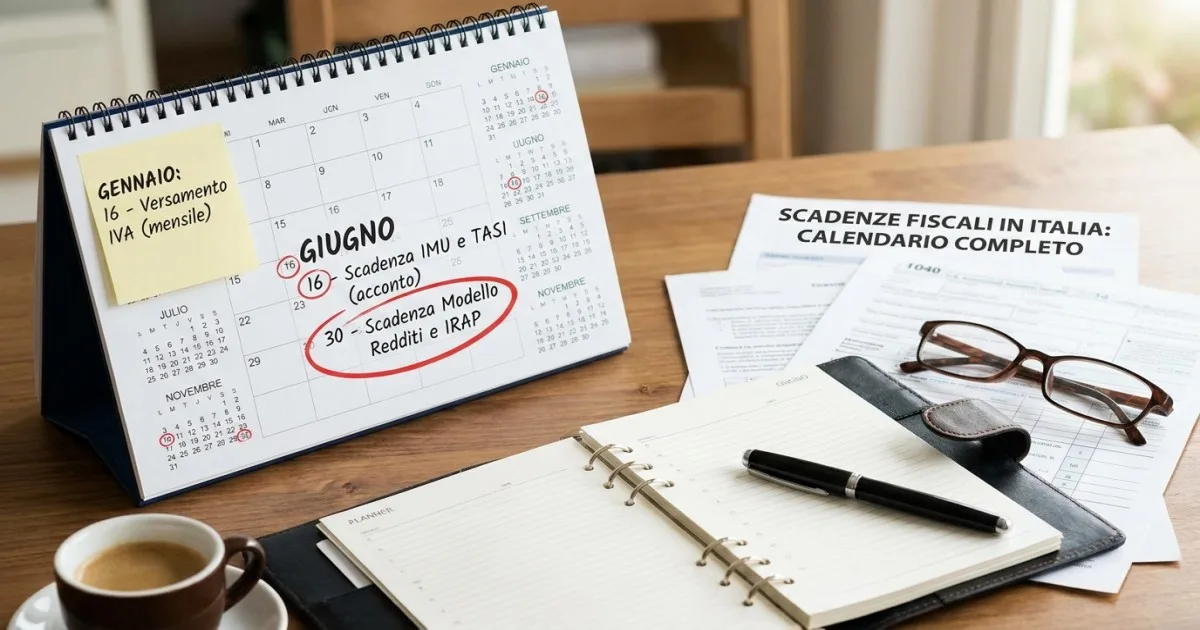
A clear tax calendar is the first line of defence against penalties and late-payment interest. In 2026, between the 730 tax form, IMU (Italy's municipal property tax), VAT and IRPEF (Italy's personal income tax) advance payments, there are over forty deadlines scattered through the year — missing even one can cost hundreds of euros. This is the complete month-by-month calendar, covering the dates that matter for most Italian taxpayers — employees, retirees and self-employed VAT holders — with practical tips to ensure you are never late.
Why tracking tax deadlines matters (and how much it costs to forget them)
A late payment is never simply a bank transfer made a few days too late. The Italian Revenue Agency (Agenzia delle Entrate) applies penalties starting at 0.1% per day for the first fourteen days, rising progressively to 30% after the ninetieth day, with statutory interest added on top (currently fixed at 2% per year). On a €3,000 IRPEF balance, paying one month late without voluntary regularisation can easily cost €90–100 in surcharges.
There is also the voluntary tax regularisation tool — the ravvedimento operoso — which allows you to self-correct missed or short payments at significantly reduced penalty rates. It works well, but only if you act before the authority issues a formal notice. Once an assessment notice arrives, full penalties become almost unavoidable.
In our experience, 90% of the tax problems we see do not stem from deliberate evasion: they come from a missed deadline because “I thought it was next month.” The good news is that the key dates are few and repeat every year with minimal changes.
First quarter: January–March, the certification season
The tax year opens with a series of obligations related to closing the previous tax period. These are primarily for tax withholding agents, VAT holders and intermediaries, but some also apply to individuals.
January: VAT, withholding tax and the RAI licence fee
The 16th of January is the first key date: payment of December's monthly VAT and IRPEF withholding tax on employment and self-employment income paid in the previous month. By the 26th of January, individuals pay the first instalment (or the full amount) of the RAI licence fee, if it is not already withheld directly from their electricity bill, as it is for most households.
February: medical expense data and stamp duty
The 2nd of February 2026 (31 January falls on a Saturday) is the deadline by which pharmacies, doctors and healthcare facilities transmit to the Health Card System (Sistema Tessera Sanitaria) the data on expenses incurred by citizens. This is not something you do yourself, but it determines what you will find pre-filled in your 730 tax return. If an expense does not appear, you will need to add it manually using your receipts.
March: the CU annual income certificates
By 16 March 2026 employers and pension bodies must transmit to the Agenzia delle Entrate and deliver to workers the CU (Italy's annual income certificate, Certificazione Unica), the document summarising the previous year's income and withholding taxes. Without the CU you cannot proceed with your tax return. For CUs relating to self-employment income, the deadline shifts to 30 April.
Second quarter: April–June, the tax-return season opens
From April the filing season officially begins. If you are an employee or retiree, this is the period to start moving if you want your IRPEF refund paid directly into your payslip from July.
April: the pre-filled return becomes available
On 15 April 2026 the channel for submitting the Redditi PF tax form opens. The 30th of April is the key date: the Agenzia delle Entrate makes the pre-filled 730 available in the secure online area of its website. From mid-May it becomes editable and submittable. Also by 30 April: the deadline to join the Rottamazione quinquies instalment plan, the latest tax amnesty on debts with the tax authority introduced by the Budget Law.
May: INPS contributions and early 730 submission
On the 16th of May: payment of April's monthly VAT, IRPEF withholding taxes and the first instalment of INPS (Italy's social-security institute) contributions for tradespeople and retailers. On a practical level, anyone who wants their IRPEF refund paid directly in July should submit the 730 tax form by 31 May — it is a “voluntary” deadline, but it makes a significant difference to when you receive the refund.
June: the big IMU and IRPEF deadline
June is probably the busiest month of the tax year. On 16 June 2026 two major deadlines fall:
- IMU advance payment 2026: 50% of the tax calculated using the 2025 rates. Those who prefer can pay the full annual amount in a single payment by this date.
- IRPEF 2025 balance and first IRPEF 2026 advance: the point at which self-employed VAT holders and taxpayers with a tax liability from their return pay what they owe.
Those who prefer can defer the IRPEF balance and advance payment to 31 July 2026 with a 0.4% surcharge. It sounds small, but on €5,000 that is €20 — and if liquidity is tight in June, it is often worth it.
Third quarter: July–September, the 730 months
July and August are relatively quiet for those without VAT registration. September, however, closes the 730 window and starts the final countdown.
31 July is the deadline for those who chose to defer the IRPEF balance payment with the 0.4% surcharge. In August, Italian tax rules provide a default twenty-day deferral: deadlines falling between 1 and 20 August are automatically pushed to 20 August without penalty. It is one of the few genuinely taxpayer-friendly aspects of the Italian fiscal calendar.
30 September 2026 is one of the most important dates of the entire year: it is the final deadline for submitting the 730 tax form, both pre-filled and standard. After this date the 730 is no longer available and you must use the Redditi PF tax form, with refund processing times that stretch from a few weeks to over a year. The difference is concrete: a €1,500 refund received in November (via 730) versus waiting until January 2028 (via Redditi PF) are not the same thing.
Fourth quarter: October–December, advance payments and IMU balance
The final quarter closes the year with the heaviest amounts: the second IRPEF advance and the IMU balance, two items that together can run into several thousand euros for many families.
October: corrections and the Redditi PF form
26 October 2026 (the 25th falls on a Sunday) is the last day to submit an amended 730 — a correction to a form already filed, if you have noticed a qualifying expense you missed. It is an opportunity few people know about, yet it can recover hundreds of euros of missed credits each year.
November: the Redditi PF form and the second advance
2 November 2026 (the 31st falls on a Saturday) is the deadline for submitting the Redditi PF form. 30 November is the deadline for the second IRPEF, IRES (Italy's corporate income tax) and IRAP (Italy's regional production tax) advance payment: for taxpayers with income above €51,653 this represents 60% of the total advance. Many forget that the second advance, unlike the first, must be paid in a single lump sum — it cannot be spread over instalments.
December: IMU balance and VAT advance
16 December 2026 is the deadline for the IMU balance, calculated using the final rates set by your municipality for the current year. For this reason it is always worth checking your municipality's website (or Finanze.gov.it) to see whether the rates have changed since 2025: if they have, the December balance may be meaningfully different from the June advance. 27 December (the 26th is a public holiday) is the deadline for the annual VAT advance payment for those required to make it.
Deadlines for VAT holders and freelancers
If you have a VAT registration (partita IVA), in addition to all the deadlines above you need to manage a series of recurring monthly or quarterly obligations depending on your tax regime. The 16th of every month is a date to mark permanently in your calendar: monthly VAT, IRPEF withholding taxes, and INPS contributions for employees and Gestione Separata contributors.
Those on the flat-rate scheme (regime forfettario) have a much simpler tax life: no periodic VAT, no quarterly LIPE (Italy's quarterly VAT reporting declarations). However, the June and November payments for substitute tax and INPS remain. Social-security contributions for tradespeople and retailers follow four fixed deadlines: 16 May, 20 August, 16 November and 16 February of the following year. These are significant payments — often between €1,000 and €2,000 each — that are best planned well in advance.
A classic mistake we often see: VAT holders forget the LIPE deadlines (quarterly VAT reporting declarations), which must be submitted by the last day of the second month after the reference quarter. They are “silent” obligations but carry penalties of €500–2,000 for each missing submission.
Deadlines for employees and retirees
If you are an employee or retiree with no other income, your tax life revolves around very few dates. Here are the four you truly need to know:
| Date | Obligation | Who it applies to |
|---|---|---|
| 16 March 2026 | Receive CU income certificate from employer | All employees and retirees |
| 16 June 2026 | IMU advance payment (if you own a non-primary property) | Property owners (not primary residence) |
| 30 September 2026 | Submit 730 tax form | Those with qualifying expenses or multiple CUs |
| 16 December 2026 | IMU balance payment | Property owners (not primary residence) |
Note that not all employees are required to file a 730: if you have a single employer and no significant qualifying expenses, the year-end tax reconciliation has already been done through your payslip and the return is optional. But if you have incurred medical expenses, mortgage interest, renovation costs or claimed the ecobonus, filing is almost always worth it — and it often means a few hundred euros in refunds.
How to stay on top of deadlines
The good news is that Italian tax deadlines follow a fairly predictable rhythm. The 16th of the month is almost always a “tax date”; June and December are the months with the big payments; September is the 730 month. With a little organisation, the calendar becomes manageable even without an accountant.
Our practical advice: set three reminders in your phone calendar — one ten days before the deadline (to prepare documents and make sure funds are available), one three days before (final check) and one on the day itself. It sounds obvious, but it dramatically reduces last-minute scrambles. For VAT holders, the Agenzia delle Entrate provides an up-to-date online deadline calendar, useful particularly for checking any extraordinary extensions.
For a broader look at how the Italian tax system works, see our complete guide to taxes in Italy, and for a detailed breakdown of available credits and how to maximise them, our guide to Italian tax deductions.
What happens if you pay late: voluntary tax regularisation
If you have missed a deadline, the first thing to know is that not all is lost. The ravvedimento operoso (voluntary tax regularisation) allows you to independently correct an omitted or insufficient payment, with penalties that decrease the sooner you act. Here are the main bands:
- Within 14 days: 0.1% per day of delay (sprint regularisation)
- Within 30 days: fixed 1.5% on the tax owed
- Within 90 days: 1.67%
- Within 1 year: 3.75%
- Beyond 1 year: 4.29%, with further increases in subsequent periods
Statutory interest at the current rate is added on top of these penalties. A concrete example: an IRPEF balance of €2,000 paid 20 days late. Penalty = €30 (1.5%), interest ≈ €2. Total to pay: €2,032. Far less than the €600 (30%) full penalty in the event of a formal audit.
In our view, voluntary regularisation should always be done immediately: waiting and hoping it “slips through” is a strategy that fails in 70% of cases, because cross-checks between the Agenzia delle Entrate and banks are now automated.
Put three dates in red on your calendar — 16 June, 30 September, 16 December — and you have already covered 70% of the tax appointments that matter. The rest is a matter of habit and a good relationship with your accountant, if you have one. If you do not, and your situation is straightforward, the pre-filled 730 is today a surprisingly effective tool.