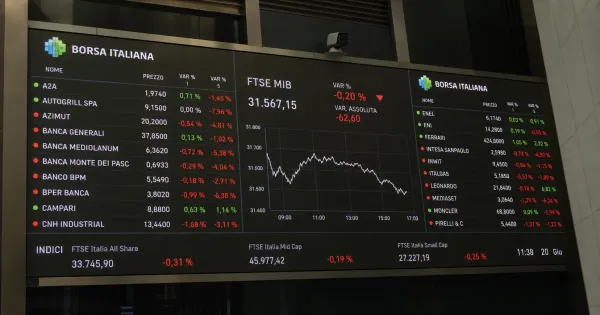
The Italian stock market is having one of its best years in a decade. The FTSE MIB — Milan’s benchmark index — closed at 47,656 points on April 24, after touching a 2026 high of 48,958 on April 17, with a year-to-date gain of over 27%. Those numbers put the index within 2,000 points of its all-time record set in 2000, and reflect a strong revaluation in banking, energy, and luxury stocks. Understanding how a stock market is valued, which sectors drive gains, and what “Italian stock market value” actually means matters both for investors in individual stocks and for anyone considering ETFs tracking Italy.
What Borsa Italiana is and how its value is measured
Borsa Italiana is Italy’s main stock market, managed since 2021 by Euronext after its acquisition from the London Stock Exchange Group. On the MTA (electronic stock exchange), roughly 220 companies are listed; another approximately 200 trade on Euronext Growth Milan, the market for smaller firms. Together they represent over 80% of the total market capitalization of Italian companies.
The “value” of the stock market is measured in two different and complementary ways. The first is total market capitalization: the sum of the market values of all listed companies, calculated by multiplying each company’s outstanding shares by its current price, then adding everything up. In 2026, Italy’s total market cap sits around €760–€800 billion, up from €690 billion at end-2024.
The second is through market indices, which capture the movement of a representative sub-set. The FTSE MIB — the most closely followed — condenses the performance of the 40 most-capitalized companies into a single number. When someone says “the market rose 5%,” they usually mean the FTSE MIB, not total market cap.
The FTSE MIB in 2026: key numbers
The FTSE MIB tracks Italy’s 40 largest companies by market cap, free float, and liquidity. Those 40 names account for over 80% of the entire market’s value. The index is reviewed quarterly, and rebalancing can shift weightings significantly.
| Indicator | Value | Reference |
|---|---|---|
| Last close | 47,656 points | April 24, 2026 |
| 2026 high | 48,958 points | April 17, 2026 |
| YTD performance 2026 | +27.83% | Year to date |
| Last-month change | +9.93% | March–April 2026 |
| All-time high | 51,273 points | March 7, 2000 |
The number that stands out is the year-to-date gain: over 27% in four months. For context, the US S&P 500 grew 4–5% in the same period, Germany’s DAX 9%, France’s CAC 40 11%. Borsa Italiana was by far the best-performing major European index in the first four months of 2026 — the product of a specific combination of macro factors and sector dynamics.
Who’s driving it: the index heavyweights
Three stocks dominate by market cap and power the FTSE MIB. ENEL has surpassed €116 billion in market value, reclaiming the top spot. Intesa Sanpaolo is second at €115 billion, UniCredit third at €114 billion. Those three alone are worth as much as the other 37 combined (excluding the very largest), and that concentration has direct implications for investors.
Behind the top three come Generali, Ferrari, Eni, Stellantis, Mediobanca, and Banco BPM — each with market caps in the €30–€60 billion range. These first ten stocks account for over 60% of the entire index. When they rise or fall, the FTSE MIB follows. Buying an ETF on the FTSE MIB is, in practice, a bet mainly on banks, energy, and a handful of major industrial names.
The sectors that drove 2026
Sector analysis for Q1 2026 shows gains heavily concentrated. Italian banks led the rally on the back of still-high net interest margins, record dividends, and ongoing M&A activity (UniCredit pursuing BPM, Mediobanca and Generali). Banking stocks in the FTSE MIB averaged +35–45% year to date.
Energy benefited from stabilizing oil prices and renewed European interest in nuclear power. Eni and ENEL gained roughly 18% and 22% YTD respectively. The luxury sector, after the 2024–2025 dip, turned positive again: Ferrari +15%, Moncler +12%, Brunello Cucinelli +20%.
Regulated utilities (Snam, Terna, Italgas) grew more modestly, in the 5–8% range, in line with their defensive nature. Smaller-cap stocks on the FTSE Italia Mid Cap and Small Cap outperformed: mid-caps rose 22% YTD, small-caps 15%.
Why Borsa Italiana outperformed Europe
The 2026 outperformance has clear roots. Three factors converged at the same time.
The first is the FTSE MIB’s sector composition: with banks weighing over 35% of the index (versus roughly 12% of the DAX and 10% of the CAC 40), Italy’s benchmark disproportionately benefits from high banking margins and sector consolidation. Italian banks collectively posted record profits exceeding €35 billion in 2025, and are on track to repeat in 2026.
The second is international fund flows: after years of structural underweighting on Italy, major European and US asset managers started adding Italian stocks back to their portfolios. The BTP–Bund yield spread tightened below 90 basis points — a sign of growing confidence in Italy — creating room for equities as well.
The third is a supportive macro backdrop: Italian inflation has settled steadily below 2%, the ECB is in an ongoing rate-cutting cycle (Deposit Facility at 2.25%–2.50%), and GDP growth is projected at 0.9–1.1% for the year. A “Goldilocks” scenario — neither too hot nor too cold — which historically is the most favorable environment for equities.
How to invest in Borsa Italiana: concrete options
For an Italian investor, there are three main ways to gain exposure to the Milan market, each with different characteristics.
The first is buying individual stocks directly. You pick 5–10 FTSE MIB names and build a custom portfolio. Advantages: maximum control, ability to overweight high-conviction names, direct dividends. Drawbacks: concentration risk, need for ongoing analysis, higher commissions with many orders.
The second is an FTSE MIB ETF. Products like iShares FTSE MIB UCITS ETF (IMIB), Lyxor FTSE MIB UCITS ETF (MIB), or Amundi FTSE MIB UCITS replicate the index at TERs between 0.16% and 0.30%. One trade gives you exposure to all 40 companies, weighted by market cap. For most investors, this is the most efficient option.
The third is an actively managed fund focused on Italy. These cost more (management fees of 1.5–2%) and, as we’ve seen in our other analyses, statistically struggle to beat the index. They make sense only if you believe in a specific management style — small-cap value, dividend focus — not replicable via ETF.
Taxation and dividends on Italian stocks
Capital gains on Italian stocks are taxed at 26% as a substitute tax. An Italian bank or broker applies it automatically at the point of sale. If you use a foreign broker, you must declare transactions in the Redditi PF tax form (quadro RT).
Dividends distributed by Italian companies are also taxed at 26% for individual investors. This matters because many FTSE MIB companies pay generous dividends: banks average 5–7% gross yield, utilities 4–6%, large industrials 3–5%. On a €50,000 portfolio composed entirely of FTSE MIB stocks, the dividend stream can easily reach €2,500–€3,000 a year gross.
PIR (Italy’s Individual Savings Plans) remain a tax-advantaged vehicle for investing in Italy: gains generated by a standard PIR held for at least five years are completely exempt from tax, subject to a maximum of €40,000 per year and €200,000 in total. It’s one of the few fiscally favorable vehicles that specifically rewards investing in Italian equities.
The specific risks of investing in Borsa Italiana
Banking concentration is the first structural risk. When the financial sector suffers — from a sovereign-debt crisis, restrictive regulation, or geopolitical stress — the FTSE MIB tends to fall harder than other European indices. We saw this in 2011 during the spread crisis, and in 2022 with the sharp rate-hike cycle.
The second risk is Italy-specific correlation: fiscal policy, political instability, and public-debt dynamics have a direct impact on Italian stocks, especially banks and utilities. Even with country risk at historic lows (BTP–Bund spread below 90 basis points), it can widen again quickly.
The third is lower liquidity compared to major US or Asian indices. FTSE MIB volumes are a fraction of the S&P 500’s, meaning sharp market moves can amplify volatility more than elsewhere. For large positions, this is a real factor.
How to read the index without being misled
Three practical points for anyone who follows the index regularly.
The FTSE MIB P/E ratio at mid-2026 sits around 11–12, versus 22–23 for the S&P 500 and 14–15 for the Eurostoxx 50. On paper the most “discounted” major European index — the market values Italian companies less generously than American ones, but with expected earnings that justify current prices. Watch this alongside the index’s average dividend yield (around 4.5% gross).
The FTSE MIB ex-banks — the index without financials — tells a different story: the +27% YTD drops to roughly +12–15% if you strip out the banking sector. A large chunk of the recent rally is bank-driven. For more balanced exposure, the FTSE Italia All-Share or the FTSE Italia Mid Cap diversify better.
Volume relative to price movement is a gauge of trend quality. A rising index on high volume is generally more sustainable than a rally on thin volume. In 2026, average daily FTSE MIB trading volumes held above €2.5 billion — in line with historical highs.
What to expect in the coming months
The analyst consensus for end-2026 puts the FTSE MIB in a range of 49,000–53,000 points, base case around 51,000. That would mean revisiting the 2000 all-time record and setting a new one after 26 years. The forecasts assume the ECB continues cutting rates without a reversal, Italian banks maintain 2025 earnings even if slightly down, and the BTP–Bund spread stays below 120 basis points.
Two downside risks remain. An unexpected European recession would hit banks hard (lower net interest margins, rising bad loans). A renewed spike in geopolitical tensions — particularly around energy — could drag the industrial sector and consumer spending.
Market value is also financial culture
Understanding the value of Borsa Italiana isn’t just useful if you invest directly. It helps you read financial news correctly, evaluate Italian industrial policy, and understand why a major takeover bid makes headlines for weeks. The capitalization of Piazza Affari reflects the health of Italy’s most important companies — and in 2026 that health is better than it’s been in many years.
For those who want to translate that into action: if you have no exposure to Italian equities yet, a small recurring investment plan (PAC) in an FTSE MIB ETF with monthly contributions is probably the most rational choice. If you’re already invested, check your sector allocation. After a +27% YTD driven by banks, the financial sector’s weight in your portfolio has likely grown beyond your target. Rebalancing — taking partial profits on banks and shifting to utilities or luxury — is a form of discipline that pays off on long horizons.
This article describes Italian regulations and financial products. Information is provided for educational purposes and does not constitute financial, tax, or legal advice. Rules and figures refer to the Italian regulatory framework as of the publication date and may change.