Buying Bitcoin in Italy takes just a few minutes: you open an app, verify your identity, send a bank transfer, and with a few taps you own your first satoshis. But in 2026 three things changed that make the choice of platform more delicate than it was a year ago: who can legally operate, how much tax you owe on gains, and how much the tax authority can see. Anyone starting out while ignoring these three points risks picking the wrong exchange or facing a surprise at tax time. Here is how to do it properly, from your very first euro.
Before you buy: what MiCA changed
Since July 1, 2026, only operators authorized as CASPs (Crypto-Asset Service Providers) under the European Union's MiCA regulation can offer crypto services in Italy. The old OAM register of providers has been retired, and the transition period closed on June 30. In practice, an exchange without authorization should no longer be able to serve you, and if it does, it is operating outside European law.
Italy transposed MiCA through Legislative Decree 129/2024, assigning supervision to CONSOB (Italy's securities regulator), with Banca d'Italia (the Bank of Italy) acting as co-authority. Authorized operators are listed in the single European register maintained by ESMA and receive the so-called passport: a license granted in one country is valid across the whole Union. For you, the practical takeaway is simple: before depositing a single euro, check that the platform actually appears in the CASP list. Penalties for operating without a license reach €15 million or 12.5% of annual turnover, but the real exposure falls on the user, who without authorization has no meaningful protection if withdrawals are frozen or the platform fails.
Choosing the right exchange: the check that actually matters
The question is not "which exchange lists the most coins," but "which one is authorized, moves my euros cheaply, and keeps me compliant." You have three concrete routes, each with a different trade-off.
The first is authorized Italian exchanges. Cryptosmart, based in Padua, obtained a full license from CONSOB and Banca d'Italia in June 2026 and can act as a withholding agent (sostituto d'imposta): it calculates and pays the tax on your behalf, a huge advantage for anyone who does not want to wrestle with the math. Young Platform, based in Turin and backed by Azimut, secured authorization for eight of the ten regulated services. The second route is the large international exchanges operating in Italy under the European passport: Kraken (authorized via the Central Bank of Ireland), Coinbase, Bitpanda, Finst. They offer deeper liquidity and mature apps, but you handle the tax filing yourself. The third is neobanks and generalist apps, convenient but often limited: many do not let you move your Bitcoin to an external wallet, and their spreads are wider.
| Where to buy | Strengths | Limits |
|---|---|---|
| Authorized Italian CASP (Cryptosmart, Young Platform) | Support in Italian, direct CONSOB protection, can act as tax withholding agent | Fewer trading pairs and advanced features than the global players |
| International exchange with EU passport (Kraken, Coinbase, Bitpanda) | High liquidity, many cryptocurrencies, proven platforms, free SEPA transfers | Tax filing is on you, support sometimes in English only |
| Neobanks and generalist apps (Revolut and similar) | Everything inside one app you already use for payments | Often no transfer to an external wallet, wider spreads, limited selection |
One detail that catches newcomers off guard: Tether (USDT), the world's most widely used stablecoin, has been removed from trading on MiCA-compliant platforms. On regulated exchanges the available stablecoins are mainly USDC and EURC. That is not a problem if you only want to buy Bitcoin, but it signals how much the landscape has shifted. Watch out too for well-known names leaving the European scene: KuCoin was banned by the Austrian regulator, Gemini left the Union, and Binance's position in the EU market is in serious flux. Always verify the current status on CONSOB's CASP page or in the ESMA register before opening an account, because a regulatory standing can change quickly and should be checked the same day.
Buying Bitcoin step by step
On any serious exchange, the process always follows the same steps. First, registration with identity verification (KYC). You will need a valid ID, your Italian tax code (codice fiscale), and usually a selfie or a short video to confirm it is really you. This is an anti-money-laundering requirement, not a platform's choice, and any operator that skips it should be avoided.
Second, the euro deposit. The cheapest method is almost always the SEPA bank transfer, free on most exchanges, with the SEPA Instant variant crediting your account in under a minute. A credit or debit card is faster but costs more in fees, and some banks block or flag payments to exchanges. It is worth knowing that many platforms apply lower deposit limits in the first days after sign-up, rising as the account is verified: if your first transfer takes a few hours to land, that is normal. Third, the purchase itself. And here comes a choice beginners often miss.
Instant buy or order book?
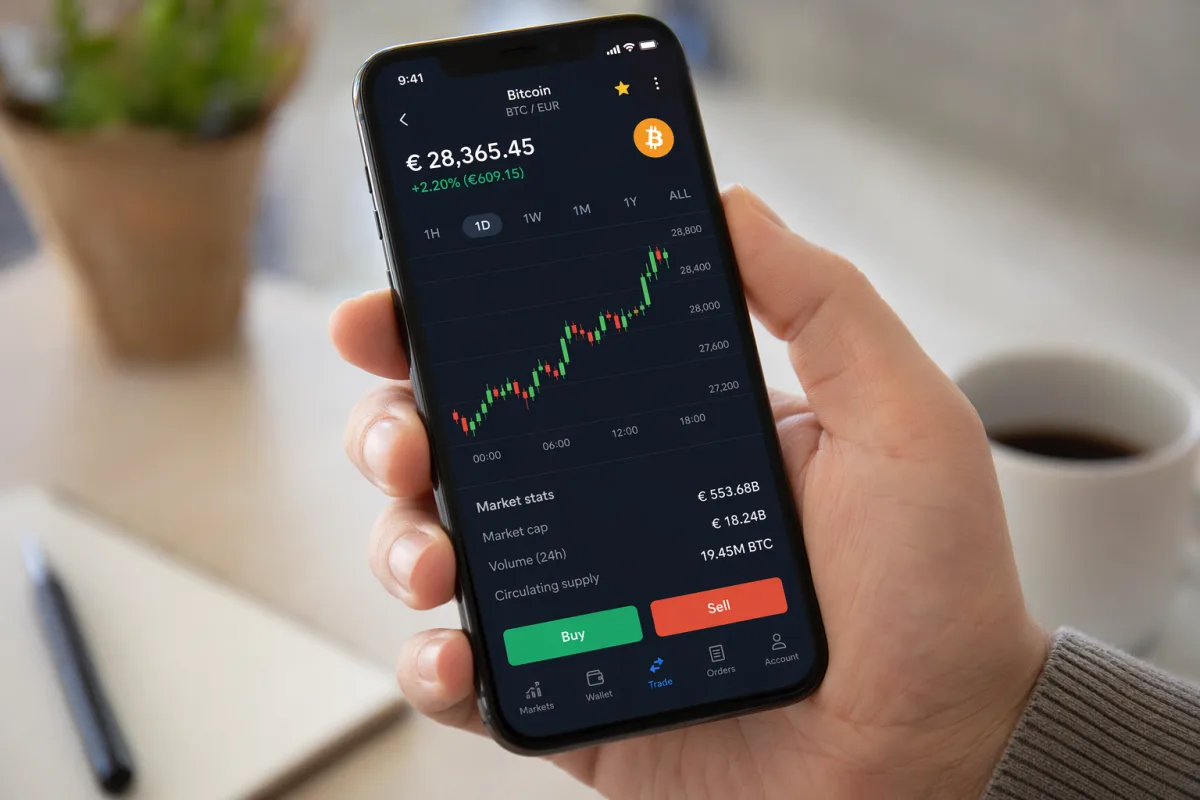
The "buy now" button is simple: you state how many euros you want to spend and receive the Bitcoin. Convenient, but you pay a wider spread, meaning a price slightly worse than the market rate. The alternative is to go through the order book, the professional platform's ledger of orders: here the fees are much lower — on Kraken Pro, for example, they start at 0.4% — but the interface intimidates at first. Our advice for beginners: use instant buy for your first purchase, then switch to the order book as soon as you gain confidence, because on recurring amounts the cost difference adds up.
Something that reassures many people: you do not have to buy a whole Bitcoin. At the current price, around €55,000, one BTC is out of reach for most people, but Bitcoin is divisible down to the eighth decimal place. You can buy €20 worth, receiving a fraction (about 0.00036 BTC). You can check the real-time value with our crypto converter before deciding the amount.
Where to keep your Bitcoin after buying
Once you own the Bitcoin, you have two options for storing it. The first is to leave it on the exchange, in the platform's custodial wallet: practical and immediate, but the private key is held by the exchange, not by you. The second is to move it to a personal wallet. Wallets split into hot (software on a phone or computer, always connected, convenient but more exposed to attacks) and cold (hardware devices such as Ledger or Trezor, kept offline, far safer for meaningful amounts).
The crypto world has a saying worth taking seriously: "not your keys, not your coins." As long as the Bitcoin sits on the exchange, you depend on its soundness. For small amounts you move often, keeping them on an authorized exchange is perfectly fine. But if you accumulate significant sums you want to hold long term, a hardware cold wallet is, in our view, the sensible choice: a one-time cost of a few dozen euros in exchange for full control over your funds.
Moving to a personal wallet, however, comes with a responsibility you did not have on the exchange: the seed phrase, the 12 or 24 words that let you recover the wallet. Lose them and you lose the Bitcoin for good, with no customer service to help. They should be written on paper and kept safe, never in a photo on your phone or a file in the cloud. A mistake we see often is underestimating this step: most permanently lost funds come not from sophisticated attacks, but from keys stored carelessly.
How much to invest, and with what strategy
Bitcoin remains an extremely volatile asset, and anyone telling you otherwise is selling you something. Just look at the recent numbers: after touching an all-time high of nearly €108,000 in October 2025, the price fell far enough to roughly halve in the following months. Whoever bought at the peak, convinced it would rise forever, learned the lesson the expensive way. That is why the first rule is the oldest one: invest only what you are prepared to lose.
In our experience, for someone approaching the sector it makes sense not to exceed 3-5% of total wealth in Bitcoin. The second rule is how you enter: instead of putting everything in at once, a dollar-cost-averaging plan — buying the same amount at a fixed cadence, say €50 a month — cushions the swings and takes the pressure of timing the market off your shoulders. It is a boring method, and that is exactly why it works. It is also worth deciding your horizon upfront: Bitcoin has historically rewarded those who stay for years, not those who jump in and out each week chasing the chart. Setting in advance the gain or loss at which you would sell spares you the impulsive decisions made in moments of panic or euphoria, which are precisely when people get it most wrong. Bitcoin is the entry point, but for a broader view of the risk-return balance across asset classes, see our guide to high-yield investments, and if you are wondering what to buy beyond Bitcoin, we cover it in our analysis of the most important cryptocurrencies of 2026.
Taxes on Bitcoin: the 33% many people get wrong
This is where most mistakes happen, often in good faith. Since January 1, 2026, capital gains on cryptocurrencies are taxed at 33%, up from 26% the previous year. The increase was set by the 2025 Budget Law (Legge di Bilancio) and confirmed by the 2026 one. There is talk of a "cut to 26%," but it is a trap: that reduced rate applies only to euro-denominated electronic-money tokens compliant with MiCA — certain stablecoins. Bitcoin, Ethereum, and other cryptocurrencies stay at 33%. Treating your BTC as a stablecoin on your return can cost you dearly.
There is more: the old €2,000 exemption disappeared in 2025. You now pay from the first euro of gain. Here is a concrete example. You buy €1,000 of Bitcoin and sell it a few months later for €1,400: the gain is €400, on which you pay 33%, or €132. Until 2024, that same gain, below €2,000, owed nothing. For reporting, Bitcoin held is entered in the Quadro RW of the Redditi model (or the new Quadro W of the 730) — the sections of the Italian tax return used for monitoring foreign and crypto assets — while capital gains go in the Quadro RT, following the guidance of the Agenzia delle Entrate (the Italian Revenue Agency). From 2026, crypto also enters the ISEE, the indicator used to means-test access to benefits.
Two points help you pay the right amount and not a euro more. The first is the calculation method: the gain is determined on a LIFO basis (last in, first out), so the price and date of your most recently purchased fractions are what count. The second is losses: if a trade ends in the red, that loss can be offset against future gains and carried forward for several years. This is why keeping the receipts for every purchase and sale is not fussiness but the difference between a correct return and a challenge from the tax office: without documentation, the purchase cost is treated as zero, and you end up taxed on the entire proceeds. One more thing to factor in: the European DAC8 directive requires EU exchanges to report client data automatically to the Agenzia delle Entrate. The idea that "they won't find out" belongs to the past. If you use an Italian exchange that acts as a withholding agent, most of this complexity disappears, because the platform calculates and pays for you.
How to recognize and avoid scams
The flip side of how easy it is to buy Bitcoin is the volume of scams surrounding the sector. The script is almost always the same, and recognizing it is your first line of defense. Five signals point to fraud with near certainty: the promise of a guaranteed return, pressure to invest immediately before "the opportunity vanishes," an intermediary that does not appear in the registers of CONSOB or Banca d'Italia, requests for extra payments to "unlock" withdrawals, and communication happening only through WhatsApp or Telegram. Even a single signal is enough to end the conversation.
It often starts with a sponsored ad on social media, sometimes using the face of a public figure manipulated with artificial intelligence to promise sure profits. Before entrusting money to anyone, check the company's name in the official lists of CONSOB and in its "Occhio alle truffe!" (Watch out for scams) section, which collects already-reported sites. A legitimate operator is always traceable in a public register. If you cannot find it, the answer is no.
Your first Bitcoin is more an exercise in discipline than a gamble. Start with a small amount that will not change your life, choose an authorized platform, set up a recurring purchase, and keep your receipts for the tax return. If you are unsure where to begin, an authorized Italian exchange that acts as a withholding agent removes both the doubt about legality and most of the tax paperwork. Once that is done, the hardest part will not be buying: it will be resisting the urge to check the price every hour.
This article is for informational purposes only and does not constitute financial, tax, or investment advice. Cryptocurrencies are highly volatile assets and you may lose all of your invested capital. Tax rules and the regulatory status of operators change frequently and may depend on your country of tax residence; always verify the current rules with the Agenzia delle Entrate (the Italian Revenue Agency) and CONSOB (Italy's securities regulator), or consult a qualified professional, before making any decision.