Cryptocurrency is everywhere: in the headlines, in conversations with friends, and in the portfolios of millions of Italians. But if someone asked you to explain how it actually works, you'd probably struggle after the first sentence. This guide is here to fix that: understand what crypto is, how to buy it — and, above all, how to avoid losing your money.
\n\n
Cryptocurrency: What It Actually Is (Beyond the Hype)
\nStart from the beginning. A cryptocurrency is a form of digital money that doesn't depend on any central bank, any government, or any intermediary. It runs on cryptography — hence the name — and a distributed network of computers that keeps the whole thing running.
\nThe revolutionary part isn't that it's "digital" — the money in your checking account is digital too. The difference is that when you make a bank transfer of €100, you have a sending bank, a receiving bank, the Bank of Italy, the ECB — an entire centralized control system in the middle. With Bitcoin, the transaction goes directly between you and the other person, recorded on a public ledger that no one controls and anyone can verify.
\nThink of it like passing a banknote directly to someone instead of going through a teller — with a receipt that anyone can read but no one can alter.
\n\n
Blockchain Explained Simply: The Engine Behind Crypto
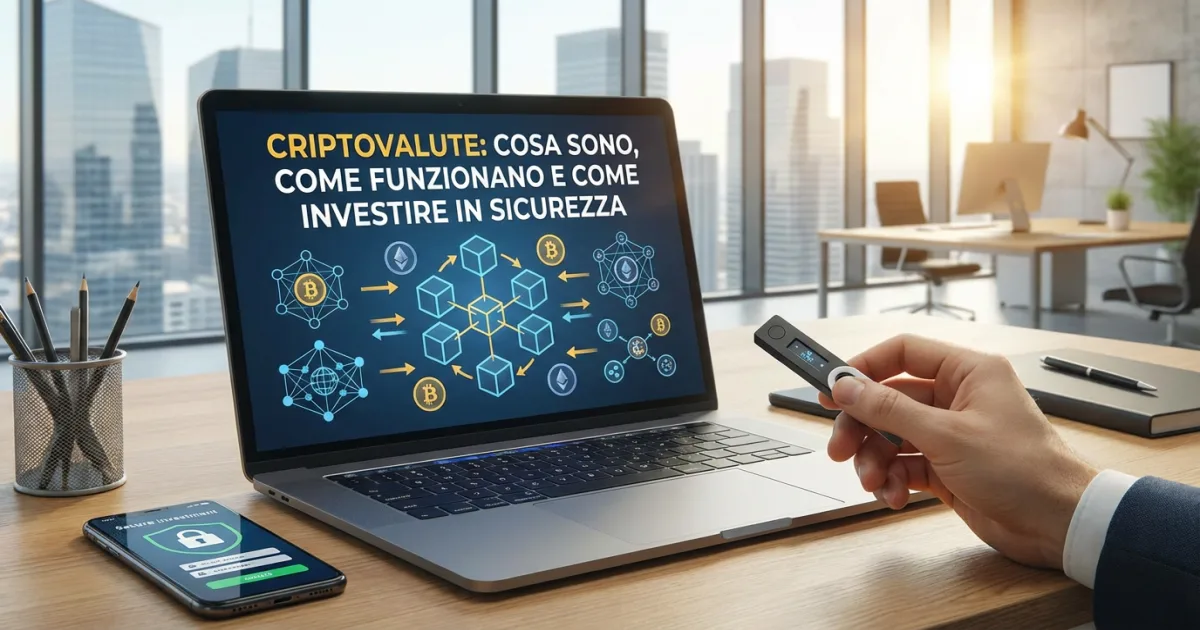
\nEvery cryptocurrency runs on a blockchain. The name says it all: a chain of blocks. Each block contains a set of transactions, and each block is linked to the previous one via a cryptographic code. Changing one block would mean recalculating the entire chain — practically impossible across a network of millions of computers.
\nPicture a public ledger that records every transaction ever made. Anyone can read it, no one can alter it. That's the blockchain.
\nBut why would anyone put their computer to work maintaining this network? Because they get rewarded with new cryptocurrency. This process is called mining for Bitcoin, or staking on more modern networks. It's the mechanism that keeps everything running.
\nA detail that often gets overlooked: not all blockchains are the same. Bitcoin has a blockchain designed almost exclusively for payments. Ethereum, on the other hand, is a programmable platform: decentralized applications, automated contracts, and tokens of every kind run on top of it. Two different technologies, two different philosophies.
\n\n
Bitcoin: The Cryptocurrency That Changed Everything
\nOctober 2008. A mysterious figure — or group — named Satoshi Nakamoto publishes a nine-page technical paper. A few months later, the first block of the Bitcoin blockchain is created.
\nToday Bitcoin is the largest cryptocurrency by market capitalization, processing millions of transactions daily and attracting institutional involvement that would have seemed like science fiction ten years ago. Investment banks, pension funds, listed companies: many have started holding it in their portfolios as a store of value.
\nWhat makes it unique is its programmed scarcity: there will never be more than 21 million Bitcoin. Of those, roughly 19.5 million have already been mined. Over time, this limit has led many to compare it to digital gold — an asset to hold, not to use to pay for your morning coffee.
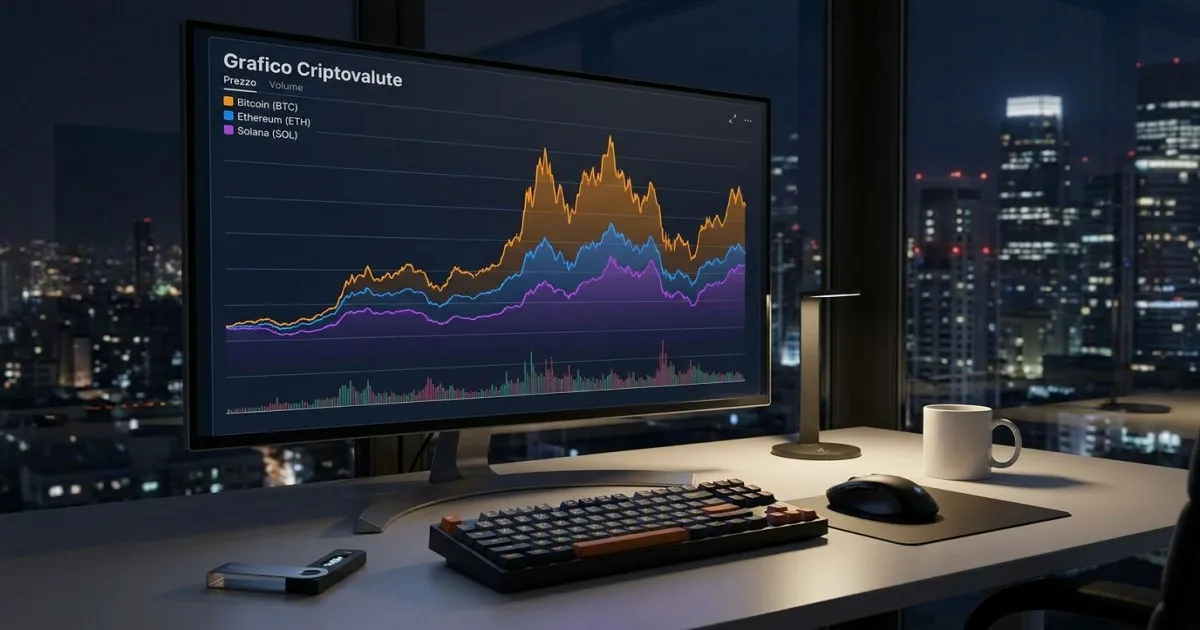
\nBitcoin is also extremely volatile — worth remembering. It has lost 80% of its value in under a year more than once in its history. Anyone who tells you it's "as safe as gold" is forgetting that gold doesn't halve in value in three months.
\n\n
Ethereum and the Main Altcoins
\nAfter Bitcoin came Ethereum, launched in 2015 by Vitalik Buterin — a Russian-Canadian who was 21 at the time. The idea was this: what if the blockchain could run programs? That's how smart contracts were born: digital contracts that execute automatically when specific conditions are met, with no need for lawyers, notaries, or intermediaries.
\nThousands of applications run on Ethereum today: DeFi protocols, NFT marketplaces, stablecoins, blockchain games. Ether (ETH) is the fuel of this entire ecosystem.
\nThere are thousands of so-called altcoins — every cryptocurrency other than Bitcoin. Some have solid projects behind them: Solana (an ultra-fast blockchain), Cardano (built with an academic approach), Chainlink (which connects the blockchain with real-world data). Many others are pure noise: hype, memes, schemes to enrich their creators. Telling the two apart takes study and a healthy dose of skepticism.
\n\n
How to Buy Cryptocurrency: The Concrete Steps
\nYou've decided to buy your first crypto. Here's how it actually works.
\nThe simplest way is to use a centralized crypto exchange: a platform where you can buy and sell cryptocurrency with euros, credit cards, or bank transfers. The most popular in Italy are Coinbase, Binance, Kraken, and Young Platform — the latter is Italian, with Italian-language support and a tax presence in Italy, which is a real advantage if you're just starting out.
\nThe typical process is:
\n- \n
- Registration and identity verification (KYC): you'll need to upload an ID document and a selfie. It's legally required. \n
- Fund your account: transfer euros via bank transfer or card. \n
- Buy: choose the cryptocurrency, enter the amount, confirm. \n
Sounds simple — and the mechanical part actually is. The hard part is deciding what to buy, how much, and above all resisting the impulse to go all-in at once because it's "going up."
\nA very common approach for long-term investors is DCA (Dollar Cost Averaging): instead of putting in €1,000 all at once, you invest €100 a month for ten months. This averages out your cost and reduces the risk of buying everything at the peak.
\n\n
Exchanges and Wallets: Where to Store Your Crypto Safely
\nKeeping your cryptocurrency on an exchange is convenient, but it isn't the safest choice. Exchanges have been hacked over the years — the most famous case is Mt. Gox in 2014, which led to the loss of 850,000 Bitcoin. More recently, the 2022 collapse of FTX wiped out the savings of millions of users worldwide.
\nThe principle to keep in mind: not your keys, not your coins. If the private keys to your crypto aren't in your possession, technically you don't own it — the exchange does.
\nWallets fall into two main categories:
\n- \n
- Hot wallets: connected to the internet, more convenient but less secure. Apps like MetaMask or Trust Wallet. \n
- Cold wallets: physical devices (like Ledger or Trezor) that store your keys offline. Less convenient, but nearly impossible to hack remotely. \n
If you're starting with small amounts, leaving your crypto on a regulated exchange is fine. But once you're talking significant amounts — say, a few thousand euros — a cold wallet is worth the investment. They cost between €50 and €150 and can protect you from losses many times larger.
\n\n
The Real Risks of Investing in Cryptocurrency
\nLet's be clear: cryptocurrency is one of the riskiest investments out there. Not to scare you off, but because the people who enter without understanding this are the ones who end up losing everything.
\nVolatility: the price can swing 30–40% in a matter of days, in either direction. A crypto portfolio isn't for anyone who needs that money in six months.
\nScams and fraud: the sector is full of fraudulent projects. Rug pulls — projects that raise funds and then vanish — are common. Promises of guaranteed 20% monthly returns are almost always scams. In our experience, anyone promising impossible returns just wants your money.
\nRegulatory risk: governments around the world are still figuring out how to regulate crypto. One wrong move by a major country can crash the market in hours.
\nIrreversible mistakes: if you send crypto to the wrong address, there's no one to call to get it back. If you lose your wallet password and don't have your seed phrase (the recovery phrase), your money is gone forever. There's no central bank to compensate you.
\n\n
Cryptocurrency Taxation in Italy
\nSince 2023, Italy has had a clear regulatory framework for cryptocurrency, updated several times since. The most recent version — in force from January 1, 2026 — changed the rules significantly.
\nFrom January 1, 2026, capital gains on cryptocurrency are taxed at 33%, with no exemption threshold: any gain must be declared, even €50. It's one of the highest rates in Europe for this type of income.
\nYou're also required to declare your crypto holdings in the RW section of your Italian tax return (or the new W section of the 730 form), even if you haven't sold anything. Capital gains go in the RT section. This isn't a tax — it's a monitoring requirement.
\nItaly's 2024 Budget Law also introduced an annual tax on cryptocurrency holdings: 0.2% per year on the balance as of December 31.\n
The EU's DAC8 directive has made automatic data sharing by exchanges with the Italian Revenue Agency (Agenzia delle Entrate) mandatory: the old idea that "they'll never find out" no longer holds.
\nIf you use Italian exchanges like Young Platform, they often provide a ready-made tax report to attach to your return. For foreign exchanges the situation is more complex: you may need an accountant with crypto experience.
\n\n\nFor more on this topic, read our guide on how to report cryptocurrency on your Italian tax return.
\n
\n
Is Investing in Cryptocurrency Worth It in 2026?
\nIt depends. On what? Mainly three things: your risk profile, your time horizon, and what proportion of your assets you're willing to tie up in a volatile instrument.
\nMost personal finance experts agree on a general principle: cryptocurrency shouldn't exceed 5–10% of a diversified portfolio. Not because it can't go up — Bitcoin has delivered extraordinary returns in some periods — but because the volatility is such that overexposure can do serious damage if the market turns against you.
\nIn 2026, some things have changed from prior years: Bitcoin ETFs are now approved in Europe too, the MiCA regulation is in force across the EU, and the infrastructure is far more mature. The market is less wild than it was in 2017 or 2021. But it remains speculative.
\nIf you want to get into crypto, do it with money you could afford to lose entirely. That's not pessimism — it's the correct way to approach any high-risk investment.
\nCryptocurrency is neither the revolution that will save the world nor the scam that some people would have you believe. It's a new technology with real applications and real risks. Those who approach it with curiosity, study, and some caution can find interesting opportunities. Those who enter chasing headlines or tips from a stranger on Telegram usually end up learning an expensive lesson.
\n\n\nWant to go deeper? Read our guide on how to buy Bitcoin in Italy safely and on how to report crypto on your Italian tax return.
\n
This article describes Italian regulations and financial products. Information is provided for educational purposes and does not constitute financial, tax, or legal advice. Rules and figures refer to the Italian regulatory framework as of the publication date and may change.