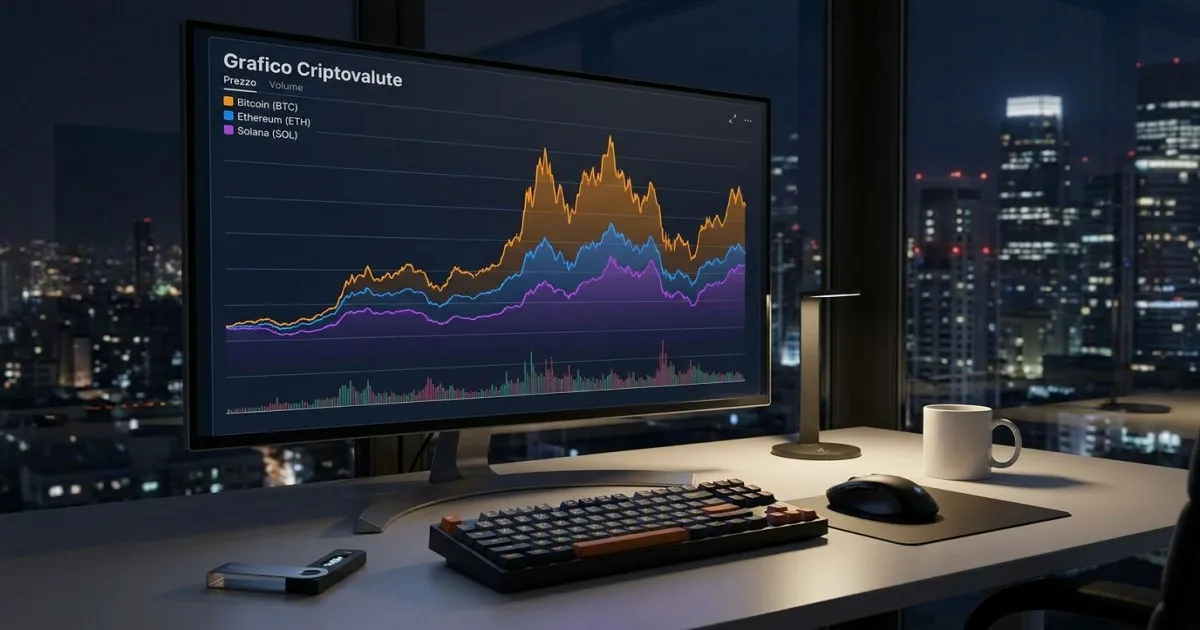
The cryptocurrency market is worth roughly $2.7 trillion as of April 2026, but 57% of that is concentrated in a single asset: Bitcoin. The other 17,000 cryptos tracked by CoinGecko split what's left, and most will disappear in the next market cycles. Knowing how to separate projects with real substance from speculative noise is the difference between a reasoned investment and a bet. Here are the cryptocurrencies that actually matter today, with current data, concrete utility, and specific risks.
\nHow to Measure a Cryptocurrency's Importance
\nMarket capitalization is the first indicator, but it doesn't tell the whole story. It's calculated by multiplying the price by the number of tokens in circulation, and it shows how much total capital is exposed to that asset. A crypto with a $50 billion market cap doesn't crash as easily as one with $50 million — simply because it takes far more money to move it.
\nThe second metric is daily trading volume. If a coin has a high market cap but low trading volume, that means almost no one is actively buying or selling it — a sign of poor liquidity, which translates into wide spreads between buy and sell prices. Then there's real utility: does that cryptocurrency do anything beyond speculation? Does it process payments? Power decentralized applications? Provide stability? The cryptos that survive bear markets are the ones that can answer "yes" to at least one of these questions.
\nThe final filter is network decentralization and the quality of the development team. A blockchain controlled by a small number of entities is more vulnerable to interference, bugs, and attacks. In our analysis, these four criteria together — market cap, liquidity, utility, decentralization — separate the serious cryptos from the rest.
\nBitcoin (BTC): The Undisputed King
\nBitcoin has a market cap of roughly $1.5 trillion and alone accounts for more than half of the entire crypto market. In April 2026 the price is hovering around $68,000–$70,000, pulling back from its all-time high of $126,000 reached in October 2025. To put it in perspective: BTC's market cap exceeds that of many of the world's largest listed companies.
\nBitcoin's dominance comes down to two things. On one side, the supply is mathematically capped at 21 million units, of which roughly 19.8 million are already in circulation. This programmed scarcity is what turned BTC into the so-called "digital gold." On the other, the approval of Bitcoin spot ETFs in the United States has opened the floodgates of traditional finance: pension funds, insurers, and asset managers can now hold BTC exposure without managing wallets or private keys.
\nWhat to Check Before Buying Bitcoin
\nVolatility remains high. In 2025, BTC swung between $50,000 and $126,000, with drawdowns of over 30% in a matter of weeks. A cautious investor shouldn't put more than 3–5% of their total portfolio into Bitcoin, especially if they're just starting out. The best way to enter is still a monthly accumulation plan: buying the same amount each month smooths out the volatility. For anyone who wants to understand how the network works, read our cryptocurrency guide covering blockchain and mining basics.
\nEthereum (ETH): Much More Than a Currency
\nWith a market cap of roughly $360 billion, Ethereum is the second-largest crypto by size. But calling it a "cryptocurrency" understates what it is. ETH is the fuel of a programmable platform on which tens of thousands of decentralized applications, smart contracts, stablecoins, and DeFi protocols run. When someone uses Uniswap, MetaMask, or an NFT marketplace, they're almost certainly paying fees in ETH.
\nThe 2022 shift to proof of stake cut the network's energy consumption by 99% and turned ETH into a yield-generating asset. Staking your ether today earns between 3% and 5% per year — similar to a bond, but with a volatile underlying asset. The 2024 Dencun upgrade drastically reduced costs on Layer 2 networks like Arbitrum and Optimism, making Ethereum far more competitive for small payments.
\nThe weak point is competition. Faster networks like Solana are eating into market share for high-frequency applications, and the debate over how far Ethereum can scale without sacrificing decentralization remains unresolved.
\nSolana (SOL): Speed at Low Cost
\nSolana became Ethereum's main competitor in 2024–2025. Its market cap is around $70 billion, with a price of roughly $125 as of April 2026 — down from the $300 peak of the prior year. Its technical edge is speed: it can process up to 65,000 transactions per second with near-zero fees, compared to 15–30 for base-layer Ethereum.
\nThis efficiency has made it the go-to platform for memecoins, instant payment apps, and high-frequency projects. But there's a downside: the network suffered several outages between 2022 and 2024 — something that never happened to Bitcoin or Ethereum. Decentralization is also lower: running a Solana validator node requires expensive hardware, which concentrates the network in fewer hands.
\nOn the plus side, spot ETFs on SOL are expected in the US during 2026. If approved, the institutional capital inflow could close the gap with ETH. It remains a more speculative bet than the top two.
\nXRP (Ripple): The Bridge Between Crypto and Banks
\nXRP was built for one purpose: making international payments faster and cheaper than SWIFT transfers. The network processes a transaction in 3–5 seconds at negligible cost, and is used by over 300 financial institutions worldwide for cross-border settlements.
\nThe long legal battle with the US SEC — which ended in 2024 with a ruling largely favorable to Ripple — removed the cloud that had hung over the coin for years. Today XRP has one of the highest market caps in the space and maintains real-world usage, something rare in a world where most projects run on expectations alone. The drawback is that XRP is less decentralized than BTC or ETH: control of the network is heavily influenced by Ripple Labs, the company that created it.
\nAltcoins Worth Watching: Cardano, Polkadot, and BNB
\nBeyond the front runners, several altcoins have solid projects and active communities. Cardano (ADA) focuses on academic research and peer-reviewed development: it's a slower but methodical blockchain with a strong presence in digital identity projects across Africa. Polkadot (DOT) aims to connect different blockchains to each other — something like an internet of cryptos. BNB, Binance's exchange token, benefits from the enormous ecosystem behind the platform but is discounted for its dependence on a single centralized actor.
\nA mistake we often see: buying altcoins just because they're "cheap." A token at €0.50 isn't objectively cheaper than Bitcoin at €65,000 — it depends on the number of tokens in circulation. The unit price alone tells you nothing: the right metric is always total market cap.
\nStablecoins: USDT, USDC, and Their Quiet Role
\nStablecoins are cryptocurrencies pegged to a traditional currency — in most cases the US dollar. Tether (USDT) and USD Coin (USDC) dominate this category with over $200 billion in combined market cap. One USDT is always worth roughly one dollar, because the issuer claims to hold dollars or US government securities as collateral.
\nThey serve three purposes. First, they let you exit volatility without converting to euros and paying withdrawal fees. Second, they're the main instrument in DeFi: many lending or yield farming protocols run on stablecoins. Third, in countries with weak currencies, they act as a store of value.
\nThis is where an important Italian tax point comes in. From January 1, 2026, swapping a "regular" cryptocurrency for a dollar-pegged stablecoin is a taxable event: it triggers a capital gain as if you had converted to euros. The only exceptions are euro-denominated stablecoins compliant with the MiCAR regulation, which remain taxed at 26%.
\nThe Italian Tax Framework in 2026
\nAnyone investing in cryptocurrency from Italy faces a tax framework that has gotten significantly tougher. From January 1, 2026, capital gains on crypto assets are taxed at 33%, up from 26% the year before. It's one of the highest rates in Europe for this type of income.
\nThe €2,000 exemption threshold is gone: any gain is reportable, even €50. Holdings must be declared in the RW section of the Redditi PF tax form (or the new W section of the 730 form), while capital gains go in the RT section. The EU's DAC8 directive has made automatic data sharing by exchanges with the Italian Revenue Agency (Agenzia delle Entrate) mandatory: the old idea that "they'll never find out" no longer holds.
\nHere's a concrete example. You bought 0.1 BTC at €30,000 and sell today at €65,000: a capital gain of €3,500, times 33% substitute tax = €1,155 to pay. There is one partial exit: the 18% step-up, which lets you recalculate the tax basis of your crypto as of January 1 by paying a substitute tax. It only makes sense if you're expecting large future gains. For the reporting side, our guide on how to report cryptocurrency on your Italian tax return walks through the practical steps.
\nSummary: The Top 7 Cryptocurrencies in April 2026
\n| Cryptocurrency | \nMarket Cap | \nIndicative Price | \nPrimary Utility | \nRisk Profile | \n
|---|---|---|---|---|
| Bitcoin (BTC) | \n~$1.5T | \n~$68,000–70,000 | \nStore of value, digital gold | \nHigh | \n
| Ethereum (ETH) | \n~$360B | \n~$2,800–3,000 | \nSmart contracts, DeFi, NFTs | \nHigh | \n
| USDT (Tether) | \n~$140B | \n~$1 (stable) | \nStablecoin, operational reserve | \nLow (issuer risk) | \n
| XRP | \n~$120B | \n~$2.00–2.20 | \nCross-border payments | \nMedium-high | \n
| Solana (SOL) | \n~$70B | \n~$125–130 | \nHigh-speed applications | \nVery high | \n
| BNB | \n~$85B | \n~$580–620 | \nBinance ecosystem | \nHigh | \n
| Cardano (ADA) | \n~$25B | \n~$0.70–0.80 | \nSmart contracts, digital identity | \nVery high | \n
Indicative data as of April 2026. Source: CoinGecko and CoinMarketCap. Cryptocurrency prices change minute by minute.
\nHow to Pick Which Crypto to Buy Without Burning Yourself
\nThe right question isn't "which crypto will explode?" — it's "how much risk can I afford?" In our experience, the most balanced allocation for anyone entering the space looks something like 60–70% in Bitcoin, 20–30% in Ethereum, and a small slice — no more than 10–15% of the crypto portfolio — in mid-cap altcoins. Filtering out tokens with a market cap below $1 billion eliminates the vast majority of scams.
\nThe second principle is timing diversification. Going all-in at the top is the classic beginner mistake — made by people convinced they've "missed the train." A monthly accumulation plan over 12–24 months spreads the entry risk. The third principle is custody. Keeping crypto on an exchange is convenient but unsafe: if the exchange fails or gets hacked, your assets are at risk. For amounts above €2,000–3,000, a hardware wallet like Ledger or Trezor — a €70–90 investment — lets you sleep at night.
\nAnd something almost nobody says out loud: crypto shouldn't be the only asset in your portfolio. If it represents more than 10–15% of your total net worth, you're taking on disproportionate risk. Traditional ETFs, government bonds, and even your emergency cash reserve are the foundation any strategy should be built on. Our complete investment strategies guide gives you the broader picture.
\nWhat to Expect in 2026 and Beyond
\nThe crypto market remains cyclical. Historically, every multi-year Bitcoin peak is followed by a deep correction, then a new cycle. October 2025 likely marked this cycle's top at $126,000, and the current phase could drag on for several months. Traditionally, these phases are when weak projects disappear and solid ones consolidate their positions.
\nOn the regulatory front, Europe fully implemented the MiCAR regulation in December 2024: exchanges operating in Italy must now be licensed, with much stricter custody and transparency standards. In the US, the arrival of spot ETFs on Ethereum — and soon likely on Solana — continues to channel institutional capital into the sector. Over the medium term, these flows justify structural growth in market caps, but no one can predict the trajectory week by week.
\nThe important thing is not to buy crypto just because "everyone's talking about it." Peak euphoria is historically the worst time to enter, and quiet phases the best. Starting small, understanding what you're buying and why, and preparing yourself emotionally for 40–50% swings is the bare minimum to avoid getting burned.
\nPicking crypto well is less exciting than the influencer version, but it's the only sustainable path. Start with Bitcoin and Ethereum, take small positions, learn how a wallet works, then decide whether and how much to expand. The market will give you better opportunities than the ones you're chasing today.
\nThis article describes Italian regulations and financial products. Information is provided for educational purposes and does not constitute financial, tax, or legal advice. Rules and figures refer to the Italian regulatory framework as of the publication date and may change.