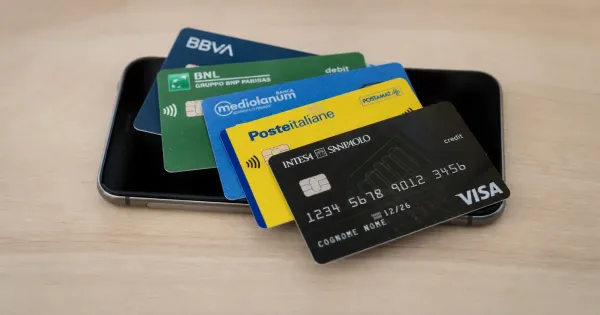
In Italy in 2026, there are more than 57 million debit cards and 15 million credit cards in circulation, and every bank account comes with at least one. Choosing a bank account and the cards that go with it cannot be treated as separate decisions: together they determine how much you pay each year to manage your money, how well protected you are in case of fraud, and what services you can use when you travel or shop online. Between debit, credit, prepaid and the new hybrid cards introduced by fintechs, the options are many: understanding which ones genuinely suit your profile is the first step to avoid paying double and leaving important areas uncovered — such as purchase security or foreign transaction fees.
The Four Types of Cards: Concrete Differences
There are four types of payment cards available in the Italian market in 2026, each with a different charging mechanism and distinct purposes. Understanding them prevents you from taking out three products that do the same thing, or conversely having only one and missing important functionality.
A debit card (historically called “Bancomat” in Italy) immediately deducts the amount from your bank account at the point of purchase. If you have €500 in your account and spend €100, €400 remains. There is no advance from the bank: you spend what you have. It is the primary payment instrument for most Italians, usually included free with the account.
A credit card lets you buy now and pay at the end of the month (or in one lump sum the following month, known as the “full payment” option). The bank grants you a credit limit of between €1,000 and €50,000, calibrated to your credit score with CRIF and Experian. Purchases accumulate over 30 days and are then charged together. It is useful for significant online purchases, car hire, travel bookings, where many merchants explicitly require a credit card as a security guarantee.
A prepaid card works like a digital wallet: you load an amount onto it and can only spend that amount. It is not necessarily linked to a bank account; some have their own IBAN (Postepay Evolution, Hype, Revolut), others are simply controlled-spending instruments. They are excellent for online purchases where you want to limit risk (it only holds €200, not €5,000), for giving a payment instrument to children, or for those without access to credit.
A hybrid card (more recent, typical of fintechs) combines debit and credit in a single instrument, with the ability to spread individual payments. Revolut, BBVA, Hype and several others offer cards that function normally as debit cards but allow you to “move” a specific payment to the end of the month, in a credit-on-demand mode. It is a flexible middle ground for anyone who does not want two physical cards.
When Each Card Type Makes Sense
The question is not “which card is best” but “which card is right for what”. The four categories have different typical uses that often make it worthwhile to have more than one.
A debit card is indispensable for everyday shopping, ATM withdrawals and small point-of-sale payments. It costs nothing (or almost nothing), charges in real time, and has PSD2 fraud protection. For anyone who wants total control over monthly spending, it may be the only instrument they need.
A credit card becomes useful in three specific scenarios. First, significant online purchases, where the circuit’s protections (chargeback) are stronger than for debit. If you buy a €1,500 television that never arrives, with a credit card you have 120 days to request a refund from the payment network; with a debit card it is more complicated. Second, car hire and travel bookings: many merchants explicitly require a credit card for the pre-authorisation deposit. Third, purchases you want to spread over time: some cards allow individual purchases to be converted into small interest-free instalments (useful for unexpected expenses of €1,000–€3,000).
A prepaid card makes sense as a secure instrument for online shopping, where you do not want to expose your main account details. Excellent for gifts, for holiday spending (you load only what you can afford to spend), and for teenagers.
A hybrid card is the rational choice for anyone who wants a single product in their wallet: it operates as debit by default, switches to credit only when needed, and you pay fees only on the transactions you choose to spread.
What Drives the Cost of a Card
The annual fee is just one cost component. To understand what a card actually costs you over the year, four other elements matter.
| Cost item | Debit card | Standard credit card | Gold/platinum credit card |
|---|---|---|---|
| Annual fee | €0 (or €5–€15) | €35–€60 | €100–€300 |
| Cash withdrawal fee at other ATMs | €1–€2 per transaction | 3–4% of amount (cash advance) | 3–4% of amount |
| Non-EU currency exchange fee | 0–2% spread | 1.5–2% spread | 0% (on many premium cards) |
| Typical monthly credit limit | €3,000–€5,000 | €1,500–€5,000 | €10,000–€50,000 |
| Average cashback | 0–1% | 0.5–1.5% | 1–3% (sometimes more on selected categories) |
Gold and platinum credit cards cost 5–10 times more than standard ones, but include travel insurance, purchase protection (reimbursement if a purchased item is stolen within 90 days of purchase), access to airport lounges, and loyalty programmes with convertible points. It is worth calculating whether the real value of the benefits covers the extra fee: for frequent travellers and high spenders, often yes; for those who only use the card for grocery shopping, no.
Credit Cards Compared: The Payment Networks
The main international payment networks are Visa, Mastercard and American Express. The difference is not cosmetic.
Visa and Mastercard are the most widespread networks in the world, accepted virtually everywhere. The main difference between the two is positioning: Visa is slightly more common in the United States, Mastercard in Europe. For an Italian consumer, they are practically equivalent.
American Express has less widespread acceptance (some small merchants in Europe and the US do not take it), but offers some of the richest rewards programmes on the market and customer service widely regarded as the best in the industry. AmEx Gold and Platinum cards cost from €250 to €720 a year and are designed for people who travel and spend heavily.
The national Pagobancomat network is cheaper for merchants but does not work outside Italy. Modern cards always combine Pagobancomat with an international Visa or Mastercard network, so they work abroad as well.
Security and Protection: What the Law Guarantees
All cards issued in Europe in 2026 are subject to PSD2 (Payment Services Directive 2), which requires Strong Customer Authentication (SCA) for almost all electronic transactions. This means two verification elements: something you know (PIN, password), something you have (smartphone with a one-time code), or something you are (fingerprint, face recognition). Since its introduction, according to the Bank of Italy, card fraud fell by 18% in 2024.
In the event of an unauthorised charge, PSD2 sets clear rules. If you report the fraud within 13 months and there has been no serious negligence on your part, the bank must refund you. For authorised transactions that are subsequently disputed (item not delivered, item not as described), chargeback works better with credit cards (90–120 days) than with debit cards (generally 30–60 days).
One protection many people overlook is purchase protection included with gold/platinum cards: if an item you bought breaks or is stolen within 90 days of purchase, the card can reimburse you. For significant purchases such as electronics or jewellery, this is a benefit with real value.
Cashback and Loyalty Programmes: What They Are Actually Worth
Cashback is the mechanism by which banks return a percentage of the amount spent. In 2026, Italian cards offer average cashback of 0.5% to 1.5% on general spending, with peaks of 5–20% on specific categories or selected partners.
To put concrete numbers on it: a household spending €30,000 a year with a card at 1% cashback recovers €300 a year. A gold card at €100 annual fee with 1.5% cashback generates €450 gross — a real net advantage of €350 compared to a free card with no cashback.
Points-based loyalty programmes (Visa Infinite, Mastercard World Elite, AmEx Membership Rewards) have variable value: American Express points are worth on average €0.01–€0.02 each, but for premium flights they can be worth €0.03–€0.04. For frequent travellers, they can become significant. For those who redeem points as Amazon vouchers, the benefit is more limited.
Cards Abroad: Where Fees Bite
When paying in a currency other than the euro or withdrawing cash outside the SEPA area, additional charges apply. On a standard debit card, the exchange spread is generally 1–2%; on a Visa/Mastercard credit card, the spread is the interbank rate plus a 1.5–2% markup. For a trip to the US with €2,000 of spending, exchange fees can amount to €30–€40.
Multi-currency fintechs (Revolut, Wise, N26) have upended this model: they use the real interbank exchange rate (the same one shown on Google) with no markup, with only small fees above certain thresholds on free plans. For frequent travellers or those who shop on foreign websites, one of these fintechs as a secondary card can save €100–€300 a year.
Foreign currency cashback on some premium cards such as BBVA (up to 20% on selected categories, by promotion) or airline co-branded cards can add further value for high spenders abroad.
Card Portfolio Strategy: How Many and Which Ones
For most profiles, a combination of two or three cards covers virtually every need. Here are the most common configurations in 2026.
Essential profile (minimal approach): a single free debit card linked to the bank account. Works for 90% of situations; the only gap is in contexts where a credit card is explicitly required (car hire, some travel bookings).
Standard profile (most Italians): a free debit card for everyday spending and a standard credit card at a modest annual fee (€35–€50) for significant online purchases, travel, and car hire. Total annual cost: €35–€50, comprehensive coverage.
Traveller profile: add a multi-currency card such as Revolut or Wise to the standard combination to reduce foreign exchange fees. Additional cost: €0–€50 per year (depending on the plan), with expected savings higher than the fee for anyone making at least 3–4 non-EU trips a year.
Premium profile: a gold or platinum credit card (annual fee €100–€300, but high cashback and insurance benefits) replaces the standard credit card. Worthwhile if annual card spending exceeds €25,000–€30,000 or if you travel frequently in business class.
Common Mistakes in Managing Accounts and Cards
The first mistake is having too many cards open and not using them. Each card is an attack surface for fraud and phishing, and unused ones are often forgotten when a problem arises. A periodic clean-up — closing cards you have not used in more than 12 months — is a good financial hygiene practice.
The second mistake is not checking your bank statements. The most damaging frauds are not the large ones (those are noticed immediately) but small recurring charges that go unnoticed for months: €4.99 a month on a service you never subscribed to, repeated for a year, amounts to €60 lost without realising it. The Bank of Italy recommends downloading and checking your statement at least once a month.
The third mistake is withdrawing cash with a credit card. The “cash advance” fee is 3–4% of the amount withdrawn, and interest accrues from the day of the withdrawal (not at the end of the month). On €200 withdrawn, the fee is €6–€8 plus interest: a financially costly habit.
The fourth mistake is ignoring revolving credit payment deadlines. If the credit card has revolving mode (automatic instalments of the balance), interest rates can reach 18–22% per annum. Converting a one-off expense of €2,000 into monthly instalments of €100 means paying roughly €250–€300 in interest over the following year and a half. Always paying the full balance at the end of the month is the golden rule.
How to Choose the Right Package in 5 Steps
Five practical questions help close the decision in half an hour.
How much do you spend on average each month by card? Below €1,000, a debit card is sufficient. Above €2,000–€3,000, a card with cashback starts to generate real value.
Do you travel outside the EU more than once a year? If so, consider a multi-currency fintech card as a secondary option, or a premium credit card with favourable exchange rates.
Do you buy online for more than €200 a month? A credit card offers stronger chargeback protection for disputed purchases. A prepaid card can complement it for purchases on less trusted sites.
Do you have recurring automatic payments (subscriptions, utility bills)? Concentrate them all on a dedicated card, so you can monitor them at a glance on a single statement.
Have you ever disputed a charge? Check your bank’s dispute procedure before you need it: banks with modern apps (BBVA, ING, Fineco, Revolut) handle disputes directly in-app; traditional banks require paperwork and longer processing times.
The right package is the one that minimises the cost of the transactions you make regularly, protects you on purchases where it matters, and does not burden you with cards you will never use. Against these three criteria, two well-chosen cards beat five cards taken out at random over the years. A bank account and cards are an integrated package: they should be chosen together and reviewed every two or three years as your spending habits evolve.

