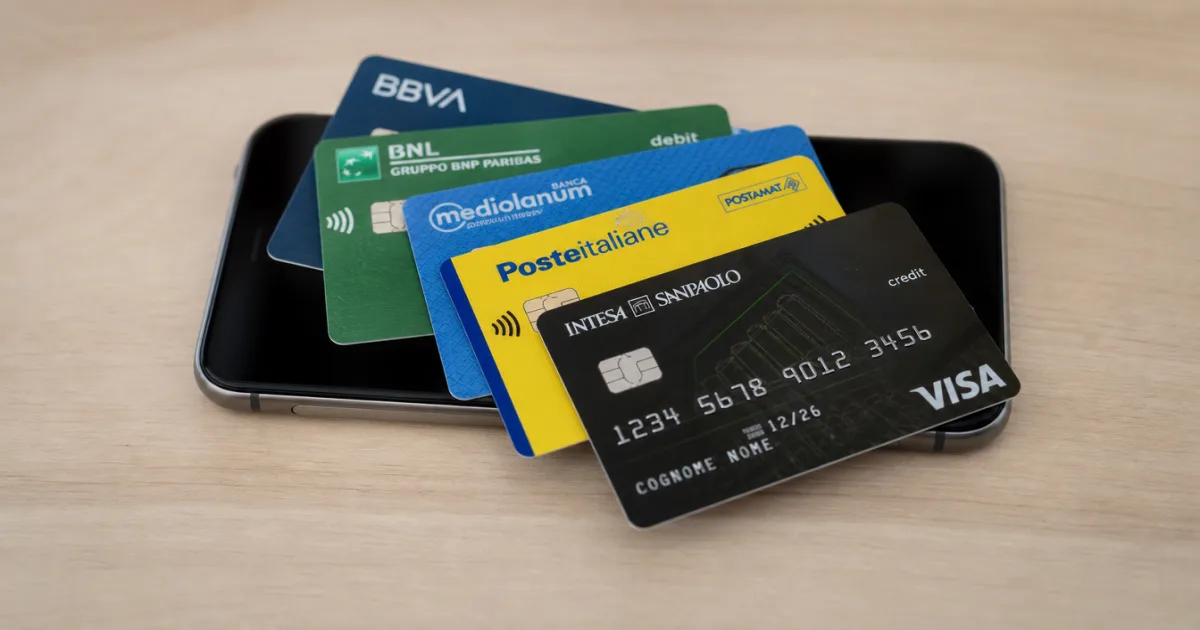
Opening a zero-fee bank account in Italy in 2026 is no longer an exception: it has become the market standard. Digital banks have forced even traditional institutions to eliminate fees and commissions, and Italian savers can now choose from a dozen completely free accounts, some of which even pay interest on the cash left in the account. The question is no longer “does a fee-free account exist” — it is “which one is right for me” — because behind the label “zero fees” lie conditions, thresholds and variable costs that can make a difference of hundreds of euros a year.
What “Zero Fees” Really Means in 2026
A zero-fee account is one with no monthly or annual fee and no charges on basic transactions. But “zero fees” does not mean “everything is free”: banks distinguish between fixed costs (annual fee, stamp duty) and variable costs (non-SEPA transfers, ATM withdrawals at other banks’ machines, credit cards).
Stamp duty is the first element to understand: €34.20 per year for individuals, payable only if the average annual balance exceeds €5,000. Below that threshold, nothing is owed. Above it, some banks (such as isybank with its current isyPrime promotion) cover the stamp duty themselves, effectively widening the meaning of “zero fees”.
The second element is waivable fee vs permanently free. A “waivable” fee disappears only if you meet certain conditions (salary credited, minimum monthly income, age requirement). A “permanently free” account is free regardless. For anyone without a fixed salary or with irregular income, the difference is significant.
The Best Zero-Fee Bank Accounts in Italy in April 2026
Here are the most relevant offers currently available, with real up-to-date conditions.
BBVA — The No-Conditions Interest-Bearing Account
Banco Bilbao Vizcaya Argentaria, the Spanish bank active in Italy since 2021, offers the most competitive zero-fee account on the market: permanently free with no salary or age requirements. Free debit card, free instant SEPA transfers, free ATM withdrawals in the euro area on amounts of €100 or more.
Its defining feature is interest paid on the current account balance. For the first six months after opening, BBVA pays 3% gross per annum on the balance, up to one million euros. After six months and until 31 December 2027, interest continues at a rate equal to 25% of the ECB Deposit Facility rate (calculated quarterly), which remains positive. Interest accrues daily and is credited to the account monthly. It is the only major bank in Italy that pays interest on current account balances with no operational conditions.
isybank — The Digital Bank from Intesa Sanpaolo
Founded in 2023 by the Intesa Sanpaolo group, isybank offers three plans: isyLight (free for life), isySmart (€3.90/month), and isyPrime (€9.90/month, full-featured).
The isyLight plan is permanently free with no conditions: it includes a digital debit card, free SEPA and instant SEPA transfers, and free withdrawals at all Intesa Sanpaolo ATMs. The isyPrime plan, normally €9.90 a month, is waived until the account holder turns 35 for customers who subscribe by 27 April 2026, with stamp duty covered by the bank regardless of age. It includes free ATM withdrawals worldwide, up to four single-use virtual cards per day, and complimentary insurance cover.
ING — Conto Corrente Arancio Più with 4% on Savings
ING is one of the established names in Italian online banking. The Conto Corrente Arancio Più has a monthly fee of €5, but this is waivable in three ways: salary or pension credited, monthly income of at least €1,000, or being under 30. Free debit card, free Mastercard Gold credit card included, free SEPA and instant SEPA transfers, free ATM withdrawals in the euro area.
The “4% for 12 months” promotion is the real incentive: by opening both a Conto Corrente Arancio Più and a Conto Arancio (the linked withdrawable savings account) by 23 May 2026, and crediting your salary by 31 August 2026, you receive 4% gross per annum for 12 months on amounts deposited in the Conto Arancio up to €50,000. After 12 months the rate drops to the “base rate,” currently around 0.5% gross — so it is a promotion to take advantage of and then reassess.
Crédit Agricole — The Online Account of the French Group
Crédit Agricole Online: no fee with no conditions, free debit card, free SEPA transfers, free ATM withdrawals at Crédit Agricole ATMs. It frequently offers welcome bonuses in Amazon gift cards (up to €300) for customers who credit their salary and reach spending thresholds within the first 60 days.
Fineco — The Option for Investors
Fineco combines a bank account with a trading platform. The fee is zero for the first year, then €3.95 per month, but is waived for under-30s and for customers meeting specific asset conditions. Debit and credit cards included, free SEPA transfers, trading commissions among the lowest in the Italian market (from €2.95 per order on Italian equities). For anyone wanting an all-in-one account that includes investments, it is the most comprehensive option.
Comparison Table: The Numbers That Matter
| Bank | Fee | Conditions | Interest on balance | Stamp duty |
|---|---|---|---|---|
| BBVA | €0/month | None | 3% for 6 months, then 25% of ECB Deposit Facility rate | Paid by customer |
| isybank isyLight | €0/month | None | None | Paid by customer |
| isybank isyPrime under-35 | €0/month | Opened by 27/04/2026, up to age 35 | None | Paid by bank |
| ING Arancio Più | €5/month waivable | Salary or €1,000/month income, or under 30 | 4% gross for 12 months on Conto Arancio (max €50,000) | Paid by customer |
| Crédit Agricole Online | €0/month | None | None | Paid by customer |
| Fineco | €3.95/month | Free first year, free under 30 | Low base rate | Paid by customer |
How to Choose the Right Account
The choice depends on how you use the account, not on which bank has the most eye-catching promotion. Three typical profiles help guide the decision.
For those with a salary or regular monthly income, ING Arancio Più is probably the best choice: fee-free with salary credited, a free Mastercard Gold credit card included, and 4% on savings parked in the Conto Arancio. For income above €1,000 a month, it is a comprehensive solution that is hard to beat.
For those with cash to keep accessible and no salary condition, BBVA is unbeatable: it is the only bank that pays interest on the current account balance with no conditions and no restrictions, with full access to your money at all times. It also works well as a secondary account for managing excess cash.
For under-35s, the isyPrime under-35 promotion open until 27 April 2026 is the richest service package at zero cost, with stamp duty covered by the bank — especially attractive for frequent travellers (free ATM withdrawals anywhere in the world) and for those who want the Intesa Sanpaolo ecosystem behind them.
For those who want to invest and manage their account in a single app, Fineco remains the benchmark. It is not the cheapest in absolute terms, but it is the most complete: trading, ETF regular investment plans, a current account, and credit cards all managed from the same interface.
How to Switch Bank Accounts: Portability in 12 Working Days
Switching accounts is simpler than most people think. Italian bank account portability rules (transposing EU Directive 2014/92) require the new bank to manage the entire transfer within a maximum of 12 working days, at no cost to the customer.
The process has three steps. First, open the new account at your chosen bank — entirely online via SPID, CIE (Italy’s electronic ID), or video identification. Then fill in the portability form with your old account details: the new bank contacts the old one, transfers the balance, moves utility direct debits and standing orders, and closes the old account. All of this is free by law and completed within 12 working days.
A practical tip: before closing your old account, check that all direct debits have actually been moved (electricity, gas, phone, subscriptions). A bill that bounces because the old account is closed is a hassle that five minutes of checking can prevent.
Common Mistakes to Avoid
The first mistake is choosing an account based only on the fee. A “free” account that charges €2 per ATM withdrawal, at 10 withdrawals a month, costs €240 a year. An account at €5 a month with free withdrawals costs €60. The numbers do not lie: estimate your actual usage before signing.
The second mistake is ignoring interest on cash balances. If you keep €10,000 idle in your account and your bank pays 0%, you are losing around €250 a year (net of tax) compared to someone keeping the same money with BBVA or ING Conto Arancio. Over five years, that is €1,250 your bank keeps for itself.
The third mistake is forgetting about promotional expiry dates. ING’s 4% lasts 12 months, BBVA’s 3% lasts 6 months, isyPrime under-35 has an opening deadline. Knowing when promotional rates expire allows you to recalibrate or switch banks without any loss.
Safety of Zero-Fee Accounts: How the Deposit Guarantee Works
A common question for anyone opening their first account with a digital bank: is my money as safe as it would be with a traditional bank? The answer is yes, and it is worth understanding why.
All banks authorised to operate in Italy are members of a deposit guarantee scheme. Italian banks (isybank, Fineco, Crédit Agricole Italia, Banca Sella and others) are members of the Italian Interbank Deposit Protection Fund (FITD), which protects deposits up to €100,000 per account holder per bank. Foreign banks operating in Italy (BBVA is covered by the Spanish guarantee fund FGD, ING by the Dutch guarantee fund DNB, N26 by the German fund) are protected by their respective national funds, which operate under the same rules thanks to EU harmonisation.
The limit is €100,000 per account holder per bank: anyone holding more than €100,000 in one account is exposed above that amount. For those managing significant capital, spreading it across multiple banks is a straightforward precaution. On a jointly held account between two people, the guarantee effectively doubles, because each holder is covered up to €100,000.
Opening an Account: All Digital, in Minutes
In 2026, opening an account online takes 5–15 minutes, entirely from a smartphone. Three things are needed: a valid identity document, Italian tax code (codice fiscale), and a smartphone with a working camera.
Identification happens in three alternative ways, at the bank’s choice: SPID or CIE 3.0 (Italy’s digital identity systems — the fastest method), an identification transfer from another account in your name, or a video call with an operator. All three methods have equivalent legal validity. A virtual debit card is activated immediately in your digital wallet (Apple Pay, Google Pay); the physical card arrives by post within 5–10 days.
A practical tip: have your old account IBAN ready if you plan to use portability, and take a screenshot of your current list of direct debits. This will be useful for checking that everything has transferred correctly in the days that follow.
BBVA vs ING: The 2026 Showdown
For anyone seeking returns on cash in 2026, the choice almost always comes down to BBVA vs ING. It is worth understanding the concrete differences.
BBVA pays 3% gross for the first 6 months on the current account balance, with no conditions and no salary requirement. It is the perfect “fast return” option: open the account, move the cash, collect monthly interest. Limitation: after 6 months the rate drops to 25% of the ECB rate (around 0.6–0.8% gross by mid-2026, depending on ECB monetary policy decisions).
ING requires your salary to be credited and a Conto Arancio to be opened (a separate savings account linked to the current account). In return it offers 4% gross for 12 months on capital up to €50,000. It is more involved to set up but more profitable for those who have a salary to credit and between €10,000 and €50,000 of cash to park.
Our assessment: for those with significant capital looking to maximise returns in the first year, ING is objectively better. For those who want zero conditions and total flexibility, BBVA is unbeatable. Nothing prevents having both: no law limits the number of bank accounts you can hold.
The One Thing That Really Matters
Having a zero-fee bank account in 2026 is a practical decision, not an ideological battle. The best account is the one that fits how you actually use your money — not the one with the loudest advertising or the biggest welcome bonus. Fifty euros in Amazon gift vouchers are not worth an app that crashes every two weeks or customer service that is impossible to reach.
Start with a simple question: how much money do you keep on average in the account, how many transactions do you make each month, do you withdraw cash often or not. The answers lead you straight to the right account, and this month’s promotions become the cherry on top, not the main course.