The Bank of Italy turns more than 130 years old in 2026, and its birth is closely tied to one of the most sensational financial scandals in post-unification Italian history: the Banca Romana affair of 1892–1893. Since then it has lived through two world wars, Mussolini's currency reform, post-war reconstruction, the years of the miracolo economico (economic miracle), the crises of the 1970s, Italy's entry into the euro and the great financial crisis of 2008–2012. Understanding the history of the Bank of Italy means understanding how Italy built its modern economic institutions, and why the Italian financial system functions as it does today.
The pre-unification context: many banks, no central bank
When Italy unified in 1861, the banking system was fragmented. In the pre-unification states six banks were authorised to issue banknotes, but none had genuine monetary authority. The new Kingdom of Italy therefore inherited six note-issuing institutions: the Banca Nazionale del Regno d'Italia (formed from the merger of the Bank of Genoa and the Bank of Turin), the Banca Nazionale Toscana, the Banca Toscana di Credito, the Banco di Napoli, the Banco di Sicilia and — after the annexation of Rome in 1870 — the Banca Romana, which had until then been the bank of the Papal States.
The Pepoli Law of 1862 had created the Italian lira as the single currency, but paper circulation remained fragmented: each institution printed its own notes in competition with the others. The arrangement was designed to avoid offending local elites, but was monetarily unstable. The first organic law of 1874 attempted to bring order, but maintained the oligopolistic structure with six authorised institutions. A single true central bank was still far off.
The Banca Romana scandal: the founding event
Between 1892 and 1893 a scandal unfolded that changed the Italian financial system forever. The Banca Romana, exploiting the property boom triggered by Rome's new status as capital, had made reckless loans to businesses and politicians and had printed banknotes well beyond the legal limits. A parliamentary commission discovered in January 1893 that the institution, authorised to issue 60 million lire, had in fact printed 113 million — almost double. The most serious practice was the duplication of serial numbers: the Banca Romana printed a second banknote with the same serial number as one already legitimately in circulation.
On 20 December 1892 the MP Napoleone Colajanni exposed the scheme in parliament. The scandal engulfed three Prime Ministers (Crispi, Di Rudinì, Giolitti), many ministers, parliamentarians and journalists. The Banca Romana's governor, Bernardo Tanlongo, was arrested. The Giolitti government fell in November 1893, although all those implicated were ultimately acquitted for insufficient evidence in 1894.
The lasting outcome of the affair was not the trial but the reform. Law no. 449 of 10 August 1893, sponsored by Giolitti as a way out of the crisis, authorised the merger of the Banca Nazionale del Regno d'Italia with the Banca Nazionale Toscana and the Banca Toscana di Credito to create a new institution: the Bank of Italy. On 5 October 1893 the founding assembly approved the new bank; on 20 December 1893 its first statute was issued by Royal Decree; on 1 January 1894 the Bank of Italy officially began operations.
The early years: a halfway central bank
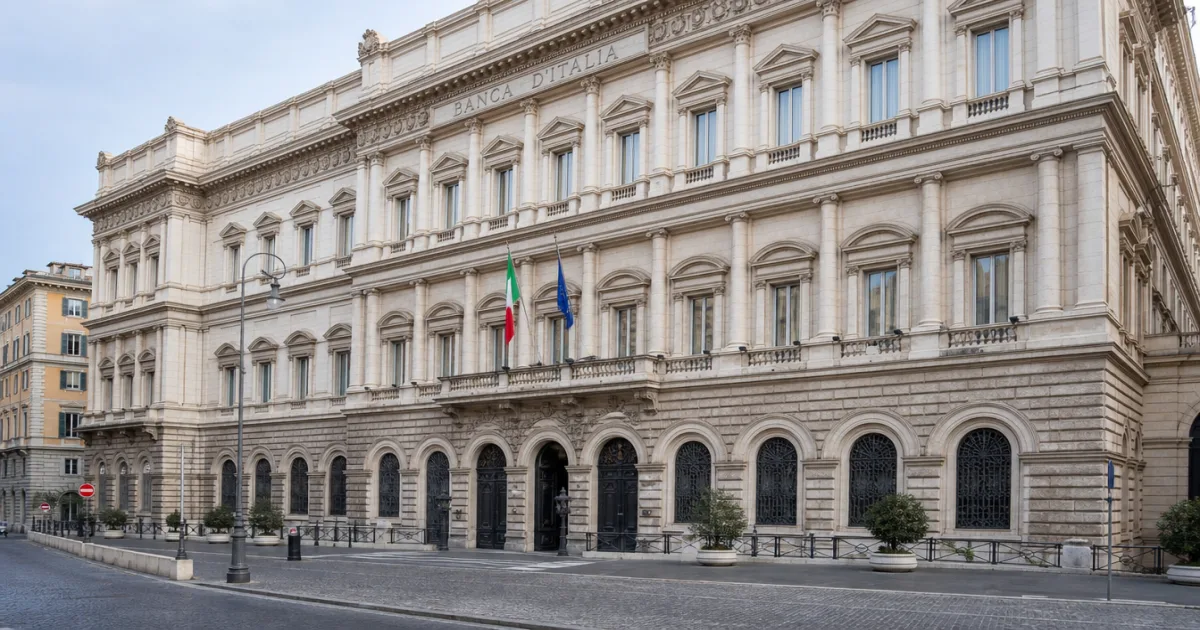
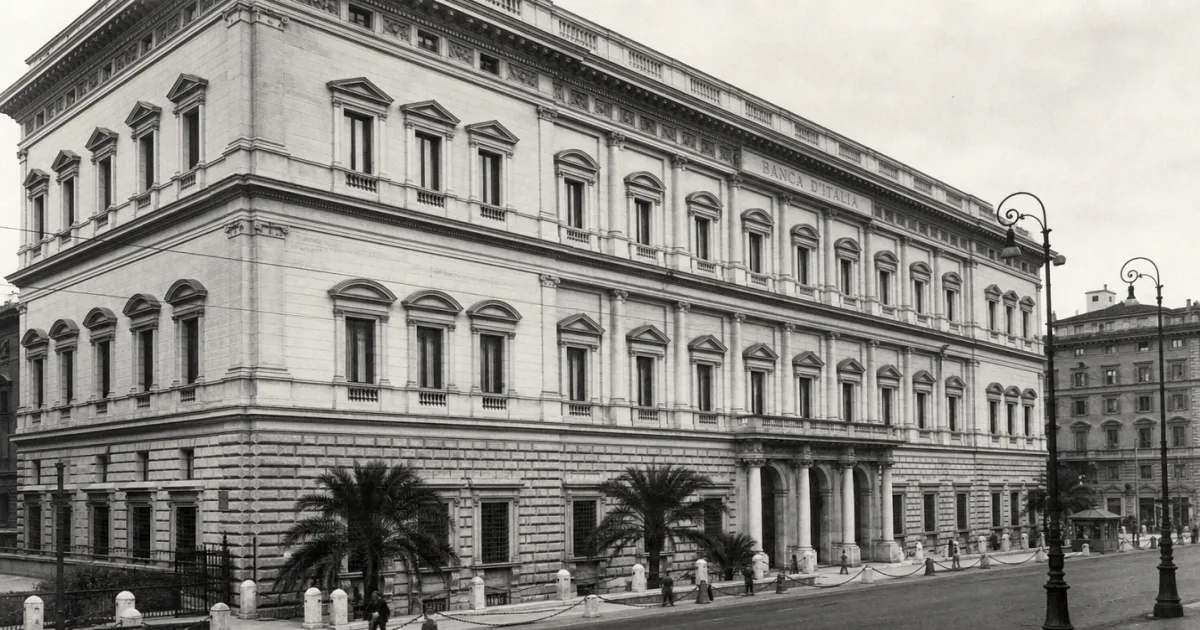
The Bank of Italy was born into a dramatic context of economic and political crisis: the lira was devalued, unemployment high, and the Sicilian Fasci peasant movement was in full revolt. The new bank inherited the premises of the Banca Nazionale in Via Nazionale, Rome — the building designed by Gaetano Koch that remains the institution's headquarters to this day.
But the Bank of Italy of 1894 was not yet a true central bank. Banknote issuance was shared with the Banco di Napoli and the Banco di Sicilia, under a profit-sharing arrangement the law maintained to avoid damaging southern Italian interests. It had no supervisory powers over credit, no Governor in the modern sense, and its senior management required government approval. The first Director General was Giacomo Grillo, formerly head of the Banca Nazionale, who resigned within a few weeks in disagreement with the measures imposed.
The 1926 reform: the modern central bank is born
For over thirty years the Bank of Italy operated in an imperfect system. The turning point came with the Banking Act of 1926 (specifically Law of 6 May 1926 no. 812), passed by the Fascist regime as part of a broader reorganisation of the credit system. Three decisive changes.
First: the Bank of Italy became the sole institution authorised to issue banknotes. The Banco di Napoli and the Banco di Sicilia lost this function, and the entire responsibility for monetary issuance was concentrated in the Rome-based institution. Italy's gold reserves were unified under the Bank of Italy's control.
Second: the office of Governor was created, with full management and representative powers. The first Governor of the Bank of Italy in the modern sense was Bonaldo Stringher, who had been Director General since 1900 and became Governor with the reform. Stringher remained at the helm until 1930, a season of great institutional consolidation.
Third: the Bank of Italy gained supervisory powers over the banking system, though still in a more limited form than today. This was the beginning of the supervisory role that would become central in the decades that followed.
The Banking Act of 1936: the long-term pillar
The 1929 crash and the years of the Great Depression forced a further reform. The Banking Act of 1936 (Royal Decree-Law of 12 March 1936 no. 375) transformed the Bank of Italy into a public-law institution and defined the regulatory framework for the Italian banking system for the next sixty years.
Three principles were central. The first was the separation between ordinary-term and medium-and-long-term credit banks, to limit liquidity risk. The second was functional specialisation: each bank operated in defined market segments. The third was the reinforcement of the Bank of Italy's supervisory powers, making it the effective supervisory authority of the credit system.
This regulatory architecture accompanied the Italian banking system through the war, reconstruction, the economic miracle and the boom years. It survived, with minor changes, until the Consolidated Banking Act of 1993.
The post-war period and the boom years: monetary stability
After 1945, Italy emerged from the war with galloping inflation, a heavily devalued lira and an out-of-control public debt. Governor Donato Menichella (1948–1960) was a key figure of the period: through tight monetary policy he pegged the lira to international exchange rates, brought inflation under control by the mid-1950s and prepared the conditions for the Italian economic miracle.
In 1947, the Bank of Italy formally assumed the role of supervisory authority over the entire banking system, a function that until that point had been shared with other bodies and now became exclusive. It was the completion of the institutional journey begun in 1926.
In the 1960s and 1970s, the Bank of Italy supported the country's industrialisation and weathered the oil crises of 1973 and 1979, with Italian inflation reaching 21% in 1980. Governors Guido Carli (1960–1975) and Paolo Baffi (1975–1979) were central figures in this phase.
The Treasury–Bank of Italy “divorce” of 1981
One of the most important dates in the Bank of Italy's recent history is 1981, the year of the so-called “divorce” between the Treasury and the central bank. Until that point, the Bank of Italy was obliged to buy any government bonds that the Treasury failed to place on the market — a practice that in effect monetised public debt and contributed to inflation.
With the letter of 12 February 1981, Treasury Minister Beniamino Andreatta and Governor Carlo Azeglio Ciampi formalised the new autonomy: from that point on, the Bank of Italy was no longer obliged to purchase unsold BOT or BTP bonds. It was a silent revolution that forced the State to fund itself at real market rates, and marked the beginning of a twenty-year battle to bring inflation and public finances back under control.
Ciampi remained Governor from 1979 to 1993, guiding Italy through the 1992 crisis (lira devaluation, exit from the European Monetary System), the Maastricht Treaty ratification and the preparation for entry into the euro.
Entry into the Eurosystem: 1998–1999
On 1 January 1999, with the launch of the third stage of European Economic and Monetary Union, the Bank of Italy became part of the European System of Central Banks (ESCB). Monetary-policy decisions were no longer national but European: the ECB Governing Council, of which the Bank of Italy's Governor is a full member, decided interest rates and money supply for the entire euro area.
On 1 January 2002 the lira was physically replaced by the euro. For the Bank of Italy this meant a profound change of role: no longer a monetary-policy decision-maker, but a national implementer of European monetary policy, a participant in decisions in Frankfurt, manager of the Italian payment system integrated into TARGET, and supervisor of Italian banks in coordination with the ECB.
The Governors of this period — Antonio Fazio (1993–2005), Mario Draghi (2006–2011), Ignazio Visco (2011–2023) — guided Italy through the most demanding crises of the euro era: the great financial crisis of 2008, the sovereign debt crisis of 2011–2012 and the restructuring of the Italian banking system. Draghi in particular left the Bank of Italy in 2011 to become President of the ECB and deliver the famous “whatever it takes” speech that saved the euro.
The Single Supervisory Mechanism: 2014
On 4 November 2014 the Single Supervisory Mechanism (SSM) of the European Banking Union came fully into force. Supervision of the largest European banks was transferred to the ECB in collaboration with national authorities. For the Bank of Italy this meant working closely with Frankfurt on the significant Italian banks (Intesa Sanpaolo, UniCredit, Banco BPM, Mediobanca, BPER, Crédit Agricole Italia, Monte dei Paschi di Siena, Banca Sella) while retaining direct responsibility for less significant banks.
It was another major transformation of the institution's role: part of the supervisory authority was shared, but in return the Bank of Italy participates directly in supervising the world's largest supranational banking system.
From 2023 to the present: the Panetta governorship
On 1 November 2023 Fabio Panetta, formerly a member of the ECB Executive Board and Director General of the Bank of Italy, assumed the office of Governor. The appointment was formalised by Presidential Decree of 10 July 2023, and the six-year term will end in 2029. Panetta succeeded Ignazio Visco, who had led the institution for twelve years.
The 2026–2028 strategic plan presented in March 2026 identifies three priorities for the next three years: responsible adoption of artificial intelligence (with the introduction of digital agents for supervisory rule-making and for inspections), strengthening the Bank's role in payment systems (supporting the digital euro project), and evolving analytical and supervisory capabilities through new technologies such as quantum computing and DLT.
In 2026 the Budget Law also introduced a politically significant interpretive provision: the gold reserves managed by the Bank of Italy (approximately 2,452 tonnes, the world's fourth-largest) belong to the Italian people. The provision does not change operational management but restates a principle of national sovereignty within the European framework.
The Governors: a gallery of key figures
From 1894 to the present, the Bank of Italy has been led by figures who have often represented the country's technical elite. A few names encapsulate entire eras.
Bonaldo Stringher (Governor 1928–1930, after serving as Director General since 1900) guided the institution through the 1907 crisis and the First World War. Donato Menichella (1948–1960) built the conditions for the economic miracle. Guido Carli (1960–1975) modernised the Italian economy. Carlo Azeglio Ciampi (1979–1993) engineered the “divorce” and prepared Italy's entry into the euro, before becoming President of the Republic. Mario Draghi (2006–2011) is one of the most influential Italian economists of the 21st century. Ignazio Visco (2011–2023) managed the sovereign debt crisis and the banking-sector restructuring. Fabio Panetta, from 2023 to the present, is guiding the institution through the technological transformation and the challenges of the new international monetary order.
What this history tells us
Three lessons emerge from the Bank of Italy's 130-year history. The first is that major institutional reforms often emerge from crises: the Bank of Italy itself was born from a scandal, the 1936 reform from the Great Depression, independence from the Treasury from the inflationary crisis of the 1970s, the Banking Union from the 2008–2012 crisis. Institutions are strengthened when they are forced to reckon with their own failures.
The second is that central bank independence is a recent and fragile achievement. For over a century the Bank of Italy shared powers with the government, was obliged to finance public debt and had senior officials approved by the executive. Full autonomy is a conquest of the past forty years, and protecting it requires continuous institutional vigilance.
The third is that the history of economic institutions is the history of the country. Understanding how the Bank of Italy was born and evolved means understanding how Italy has managed — and sometimes failed to manage — its financial crises, how it has integrated into the European context and how it has built instruments to protect savers. It is a journey that continues, and each decade adds a new chapter to the rooms of Palazzo Koch.