The Bank of Italy is the central institution of the Italian financial system, an integral part of the Eurosystem and the European Banking Union. When the ECB decides interest rates, when consumer prices fall or rise, when an Italian bank runs into difficulty, or when the digital euro is discussed, the Bank of Italy is one of the key actors behind the scenes. Understanding what it actually does — bank supervision, reserve management, monetary policy implementation, economic research, consumer protection — is important for anyone who wants to read economic news correctly and understand how the system in which their money circulates really works.
What the Bank of Italy is: the institutional framework
The Bank of Italy is a public-law institution, founded in 1893 from the merger of four pre-existing institutes, and since 1936 the exclusive central bank of Italy. Since 1998, with the launch of the third stage of European Economic and Monetary Union, it has been an integral part of the European System of Central Banks (ESCB) and of the Eurosystem, the body that manages the euro together with the ECB.
The institution's independence is guaranteed by the Italian Constitution and by the EU Treaties: the Bank of Italy receives no instructions from the government, parliament or any political body. This independence is the fundamental safeguard ensuring that monetary-policy and supervisory decisions are taken in the long-term public interest, free from political or electoral pressure.
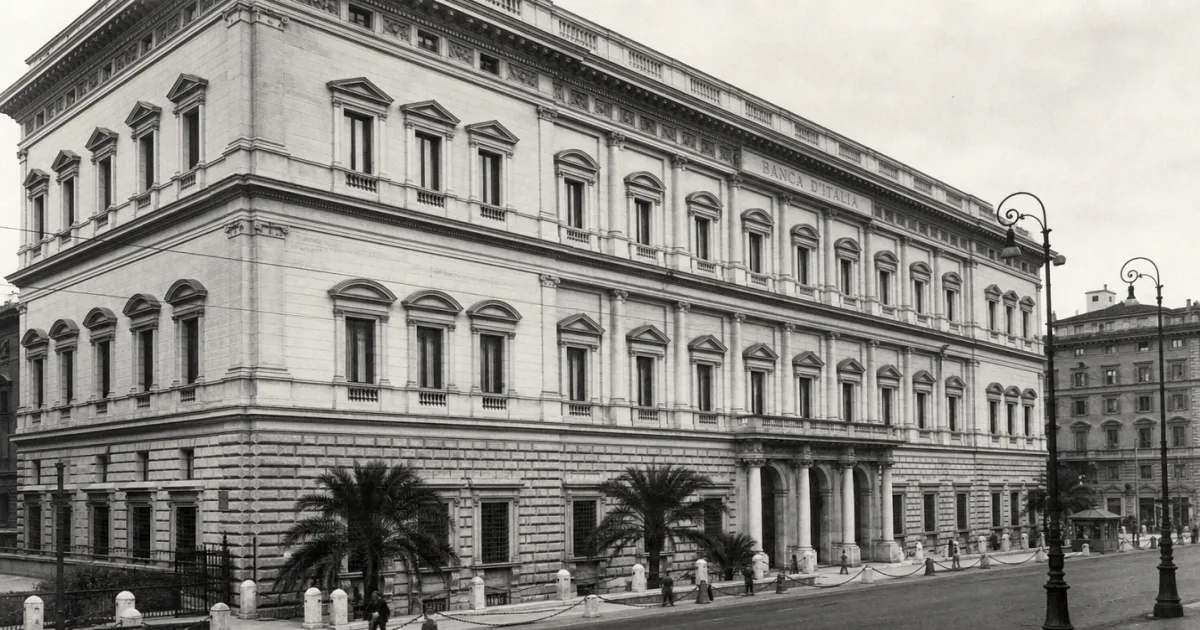
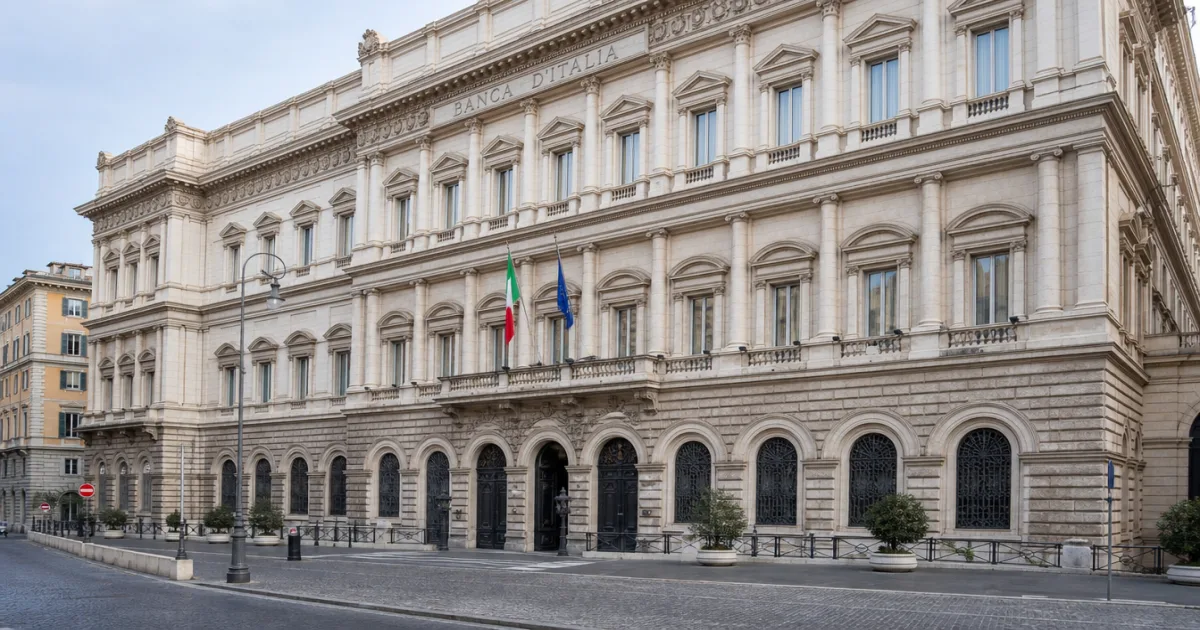
Its headquarters are at Palazzo Koch in Rome, at Via Nazionale 91. The Bank operates through a network of branches across the country, alongside provincial treasury offices and an inspection and supervisory structure covering the whole of Italy.
Governance: who runs the Bank of Italy
At the top of the Bank of Italy sits the Governing Board (Direttorio), made up of the Governor, the Director General and three Deputy Directors General. The Governor is appointed by Presidential Decree on the proposal of the President of the Council of Ministers, following a resolution of the Council of Ministers and having heard the opinion of the Bank of Italy's Superior Council. The term lasts six years and is renewable once.
Since 1 November 2023 the Governor has been Fabio Panetta, formerly a member of the ECB Executive Board and Director General of the Bank of Italy. The appointment was formalised by Presidential Decree of 10 July 2023, and the standard term will end in 2029. The Director General is Paolo Angelini, newly appointed in 2026 as part of the internal reorganisation driven by the new strategic plan. Gian Luca Trequattrini holds the role of Deputy Director General.
As Governor, Panetta is a member of the ECB Governing Council, the European Systemic Risk Board, the Board of the Bank for International Settlements (BIS), and the Boards of Governors of the International Monetary Fund (IMF) and the World Bank. He is also Chairman of the integrated Governing Board of IVASS (Italy's insurance regulator) and, since 1 November 2023, Chair of the BIS Committee on Payments and Market Infrastructures.
Monetary policy: how the mechanism works
The best-known function of the Bank of Italy is its participation in euro-area monetary policy. Since the introduction of the euro in 1999, decisions on interest rates and money supply are no longer national: they are taken by the ECB Governing Council, of which the Bank of Italy's Governor is a full member.
The ECB Governing Council meets roughly every six weeks to decide on three key rates: the main refinancing operations rate, the deposit facility rate and the marginal lending facility rate. In 2026, following the rate-hike cycle of 2022–2023 and the subsequent easing cycle, the deposit facility rate (the market's main reference) stands at around 2.25–2.5%, gradually declining from the 4% peak reached in 2023.
The Bank of Italy implements these decisions at national level: it manages refinancing operations with Italian banks, conducts economic research to support monetary-policy decisions, and contributes to the ECB Council through its own analysis of the Italian and European economy. The Bollettino Economico (Economic Bulletin), published quarterly, is one of the most widely followed publications for understanding the central bank's reading of the Italian economic situation.
Banking supervision: the watchdog of the credit system
The second major function is supervision of the Italian banking and financial system. Since 4 November 2014, with the launch of the Single Supervisory Mechanism (SSM), oversight is structured on two levels.
Significant banks (those with assets above €30 billion or of systemic relevance) are supervised directly by the ECB in collaboration with the Bank of Italy. In Italy this category includes Intesa Sanpaolo, UniCredit, Banco BPM, Mediobanca, BPER Banca, Crédit Agricole Italia, Monte dei Paschi di Siena, Banca Sella and others.
Less significant banks are supervised by the Bank of Italy according to the harmonised methodologies and standards defined at European level. This group includes cooperative banks (BCC, Banche di Credito Cooperativo) grouped under two parent institutions (ICCREA and Cassa Centrale Banca), smaller banks and non-bank financial intermediaries (leasing companies, factoring firms, consumer-credit lenders).
Supervisory activity consists of off-site monitoring (periodic analysis of balance-sheet data and risk indicators) and on-site inspections. Each year the Bank of Italy carries out hundreds of inspections covering all aspects of banking activity: credit risks, governance, anti-money laundering, handling of customer complaints, IT systems and internal procedures. Administrative penalties for serious violations can run into millions of euros.
Financial stability and crisis management
When a bank faces serious difficulty, the Bank of Italy intervenes to manage the situation and protect depositors. The tools available depend on the severity of the case.
For contained problems, intervention takes the form of recommendations, requests for capital increases or management changes. When the situation is more serious, the Bank of Italy can propose to the Ministry of Economy that the bank be placed under special administration, a phase in which management passes to commissioners appointed by the authorities.
For outright crises, since 2015 the European Bank Recovery and Resolution Directive (BRRD) framework applies: the troubled bank is subject to resolution procedures coordinated by the Single Resolution Board, with possible recourse to bail-in (losses borne by shareholders, subordinated bondholders and, as a last resort, deposits above €100,000). The Interbank Deposit Protection Fund (FITD, Fondo Interbancario di Tutela dei Depositi) guarantees in any case the full repayment of deposits up to €100,000 per depositor per bank, typically within 7 working days.
Payment systems and cash management
The Bank of Italy manages the key infrastructure of the Italian and European payment systems. Three are its main roles in this area.
The first is the operational management of TARGET Services, the Eurosystem's platform through which large-value interbank payments and monetary-policy operations flow. In 2026 the Pontes and Appia projects are under way, aimed at evolving these services, with a focus on integration with global cross-border systems and on cyber resilience.
The second concerns State treasury services: the Bank of Italy collects government revenues, executes State budget payments and manages the Treasury's current account. Since 1 January 2025 the ReTes programme (Treasury Procedures Re-engineering) has been operational, modernising the IT architecture through which hundreds of billions of euros flow each year.
The third is cash management: issuing and withdrawing euro banknotes for the Italian territory, verifying authenticity, distributing through branches and specialist centres, and withdrawing worn or damaged notes. Bank of Italy branches also offer citizens the free exchange of damaged banknotes, in accordance with ECB rules.
Consumer protection and transparency
The Bank of Italy performs an important role in protecting customers of banking and financial services, through three main channels.
The first is transparency regulation: the Bank's rules on banking transparency specify what must appear in information sheets, account statements and advertising for financial products. The ISC (Standardised Cost Indicator, Indicatore Sintetico di Costo) for current accounts, the annual percentage rate (APR / TAEG) on loans, and the information prospectus for mortgages are all documents whose content is governed by Bank of Italy rules.
The second channel is the ABF (Italy's Banking and Financial Ombudsman, Arbitro Bancario Finanziario), an independent body for the out-of-court resolution of disputes between customers and banks. Customers can approach the ABF free of charge for disputes up to €200,000, after having filed a formal complaint with the bank and received an unsatisfactory response. The ABF issues decisions that are binding on the bank, and statistics show that around 60–70% of decisions are in the customer's favour.
The third is financial education: the Bank of Italy coordinates training and outreach initiatives, publishes practical guides for citizens and runs a dedicated portal (Quello che conta) to improve Italians' basic financial literacy — an area in which Italy has historically scored below the European average.
Gold and foreign exchange reserves
The Bank of Italy holds and manages Italy's official reserves, consisting of gold, foreign currencies, IMF special drawing rights and other assets. Italy's gold reserves are among the largest in the world: around 2,452 tonnes, placing Italy fourth in the international ranking, behind the United States, Germany and the IMF.
Italy's 2026 Budget Law introduced an interpretive provision explicitly clarifying that the gold reserves managed by the Bank of Italy belong to the Italian people, within the limits set by the EU Treaties. The provision does not change the accounting treatment or the operational management, but enshrines a politically significant principle. Governor Panetta confirmed that gold and other reserves are held and managed with the sole reference to the national and European interest.
Foreign exchange reserves serve to support the country's financial stability, to provide liquidity in foreign currency in stress situations, and to support the Eurosystem's monetary-policy operations. Management follows the criteria of security, liquidity and return, in that order of priority.
Statistics, economic research and the Bulletin
The Bank of Italy produces and publishes a substantial body of economic data and analysis that feed into the public debate and policy decisions. The four most widely followed publications are these.
The Annual Report, presented every 31 May at the Shareholders' Meeting, is the reference document on the Italian and European economic situation, with the Governor's speech — closely watched by the media and markets — providing a broad overview of the economy.
The Economic Bulletin (Bollettino Economico), published quarterly, contains the updated macroeconomic forecasts of the Bank of Italy's staff on growth, inflation, the labour market and public finances.
The Financial Stability Report (Rapporto sulla Stabilità Finanziaria), published twice a year, analyses the risks to the Italian financial system and the mitigation measures adopted or recommended.
The Discussion Papers (Temi di Discussione) and Occasional Papers (Questioni di Economia e Finanza) present more technical studies by internal researchers, covering topics from monetary policy to mortgage finance, tax evasion and the housing cycle. Published weekly, they represent one of Italy's highest-quality outputs of economic research.
Innovation and new challenges: the 2026–2028 strategic plan
The 2026–2028 strategic plan, presented by Governor Panetta in March 2026, sets out the priorities for the next three years. There are three main axes.
The first is the responsible adoption of artificial intelligence. The Bank of Italy has already begun introducing digital agents for complex tasks such as supporting supervisory rule-making and inspections. Applications extend to anti-money laundering, fraud prevention and customer-service chatbots. AI is viewed as an enabler, not an end in itself: human oversight remains central.
The second axis concerns payment systems. The Bank of Italy consolidates its role in domestic and cross-border circuits, and actively supports the Eurosystem's digital euro project, assessed as a tool for providing a modern public means of payment and for preserving European monetary sovereignty.
The third is the strengthening of analytical and supervisory capabilities through more integrated use of data (including non-traditional sources) and advanced forecasting tools to identify emerging trends. Quantum technologies and distributed-ledger technology (DLT) are identified as specific development areas, alongside strengthening defences against cyber threats.
Why all of this matters to the ordinary citizen
The Bank of Italy operates far from the spotlight of day-to-day politics, but its decisions directly affect the life of anyone with a bank account, a mortgage or savings. Banking supervision is the reason deposits are protected. Oversight of payment systems is the reason a bank transfer arrives safely at its destination. Transparency regulation is the reason we know how much we are paying for a mortgage or a current account. Participation in European monetary policy is the reason interest rates today stand at 2.5% and not at 6%, as they might have been without European coordination.
Understanding how the Bank of Italy works does not require knowing the articles of the Treaty on European Union by heart: it means being able to read economic news correctly, knowing where to turn if you have a problem with your bank (the ABF), and understanding why a fall in interest rates affects the yield on a BTP (Italian government bond). It is, ultimately, one of the most important institutions in the country for managing the most tangible thing each of us possesses: our own money.